
Report on Human Rights Violations in Iran (20 November–20 December 2025): At Least 354 Prisoners Executed

30-December-2025
Category: Children، ethnic minorities، executions، Freedom of Expression، Labor and guilds، Prisoners، religious minorities، Students، Women
29 December 2025
News Categories: Freedom of Expression – Executions – Religious Minorities – Ethnic Minorities – Students – Women – Prisoners – Workers and Trades – Children
Breathing in Confinement – The past month marked one of the bloodiest periods on record in the Islamic Republic’s history with regard to violations of the right to life and the intensification of organised repression. Findings by the Prisoners’ Rights League in Iran, based on field data, independent human rights sources, testimonies from families, and local reports, indicate that during this month at least 354 prisoners were executed —an unprecedented figure that confirms a continuing and deeply alarming upward trend. This trajectory is breaking month-by-month records for the highest number of executions since the 1980s.
Between 20 November and 20 December 2025, a total of 354 executions were recorded. This represents an increase of approximately 144% compared with the same period in 2024, during which 145 executions were documented. In concrete terms, the number of executions in this month has more than doubled, marking the most severe year-on-year surge in executions for this period in at least the past four years.
These figures do not merely reflect the enforcement of judicial sentences; rather, they point to a systematic and deliberate policy of using the death penalty as a tool for political control, the creation of social terror, and the suppression of popular dissent. The accelerated pace of executions, occurring alongside growing social discontent, labour protests, and the continued resistance of political prisoners, demonstrates that the regime is employing the deprivation of life as one of its primary mechanisms for its survival.
During this month, the profound gap between on-the-ground reality and the government’s official narrative became even more apparent. Authorities of the Islamic Republic publicly acknowledged the execution of only eight prisoners, while 346 additional executions were carried out in secrecy, without public notification, independent oversight, or adherence to fair trial standards. These hidden executions—documented through disclosures by human rights activists, prisoners’ families, and independent local sources—constitute clear violations of the right to information, families’ right to know about the fate of the beloved ones, and the prohibition of inhuman and degrading treatment.
Moreover, the implementation of at least three public executions during this period signals a conscious return to the display of overt state violence. This approach is aimed not at the administration of justice, but at collective intimidation, the humiliation of human dignity, and the normalisation of death in public spaces. Under international human rights standards, public executions are unequivocally considered cruel, inhuman, and degrading treatment.
Within this broader context, the judiciary of the Islamic Republic has effectively become the backbone of the repression apparatus. Through the issuance of severe sentences, the expedited confirmation of death penalties, the widespread use of torture, forced confessions, and the systematic denial of fair trial guarantees, the judiciary violates all fundamental principles of justice. In this structure, the law no longer functions as a means of delivering justice, but rather as a quasi-legal façade to legitimise organised state violence.
At the same time, the Islamic Republic was condemned for the seventy-second time by the United Nations General Assembly for its gross, widespread, and systematic human rights violations. This condemnation underscores the persistence of structural impunity for those responsible for these crimes and the authorities’ disregard for their international obligations.
The Prisoners’ Rights League in Iran stresses that the continuation of this situation is a direct result of international inaction and the absence of effective measures.
This failure has emboldened the Iranian regime to further instrumentalise the death penalty. Under such conditions, active utilisation of international accountability mechanisms—including the principle of universal jurisdiction, judicial proceedings in national and international courts, and practical support for the protest actions of political prisoners, particularly the weekly “Tuesdays Against Execution” campaign, as well as gatherings by prisoners’ families—is not merely a human rights demand, but an urgent necessity to protect lives and prevent the repetition of these crimes.
This monthly report represents an effort to document violations and break the cycle of silence—a cycle in which prisoners’ lives are sacrificed for the political survival of those in power.
Monthly Summary of Human Rights Violations in Iran
- Execution of at least 354 prisoners
- Issuance of 18 new death sentences (including 8 political prisoners) and confirmation of 5 death sentences by the Supreme Court (including 2 political prisoners)
- Arrest of at least 183 citizens
- Death of 7 prisoners due to lack of medical care in prisons
- Issuance of flogging sentences for 13 defendants
- Sentencing of 32 political and ideological defendants to a total of 172 years, 6 months, and 27 days of imprisonment, and 538,100,000 tomans in fines
- Detention of at least 7 political prisoners for the enforcement of sentences
- Death of 45 workers and injury of at least 97 workers in workplace accidents
- Dismissal of more than 44 workers
- Documentation of 21 femicides resulting from violence against women
- Holding of over 430 protests, demonstrations, and collective actions
- Continuation of the “Tuesdays Against Execution” hunger strike campaign in 55 prisons, reaching its 100th consecutive week
- Ongoing protests by families of political prisoners, retirees, and other social groups
1- Overall Statistics of Executions in the Past Month
According to the Statistical Centre of the Prisoners’ Rights League in Iran, in the past month at least 354 prisoners were executed in various prisons across the country.
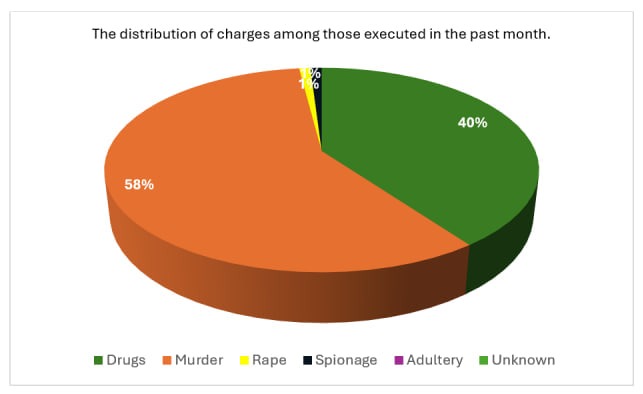
Breakdown of Charges of Executed Prisoners
- Drug-related offences: 142 prisoners
- Murder: 226 prisoners
- Rape: 2 prisoners
- Espionage: 1 prisoner
- Economic charges (disruption of the economic system): 1 prisoner
- Adultery: 1 prisoner
- Unspecified charges: 1 prisoner
The pie chart below illustrates the distribution of charges among those executed during the past month.
2- The upward trend in executions over the past nine months
From 20 March 2025 to 20 December 2025, at least 1,822 prisoners were executed in prisons across Iran.
The chart below shows the upward trend in executions over the past nine months (noting that two executions in November were reported after the publication of the initial report and were disclosed by Breathing in Confinement):
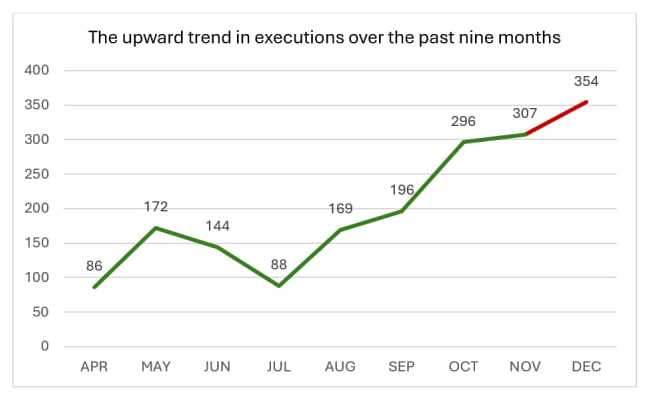
Based on documented data from the Prisoners’ Rights League in Iran, the implementation of death sentences in the past month entered an unprecedented phase of intensity, acceleration, and structural concealment. While the final figure for November stood at 305 executions, the registration of 354 executions in the past month represents an increase of approximately 16.5% compared with November — a significant rise that indicates the continuation and escalation of a policy of mass executions.
This statistical surge is not the result of ordinary judicial processes, but rather reflects the deliberate management of a cycle of killing by the authorities. This cycle has intensified in parallel with the expansion of social discontent and the continuation of civil protests, particularly the hunger strike of political prisoners under the banner of “Tuesdays Against Execution.”
The past month should be regarded as the peak of this policy in the current year — a month in which the death penalty was transformed into a central instrument of security hegemony. The sharp increase in executions, in continuation of patterns observed in previous months, demonstrates that the authorities are pursuing a policy of sustained intimidation through a combination of rising execution numbers and systematic concealment.
Within this framework, execution is employed not merely as a form of punishment, but as a political, psychological, and social instrument for controlling society. Accordingly, the recording of 354 executions in the past month is not simply a statistical figure; it is a clear indication of the consolidation of a state pattern of repression through death — a pattern that, by crossing previous thresholds, has systematically violated the right to life and reduced human dignity to a tool securing regime’s hegemony.
The bar chart below shows the increase in executions in December over the past five years.
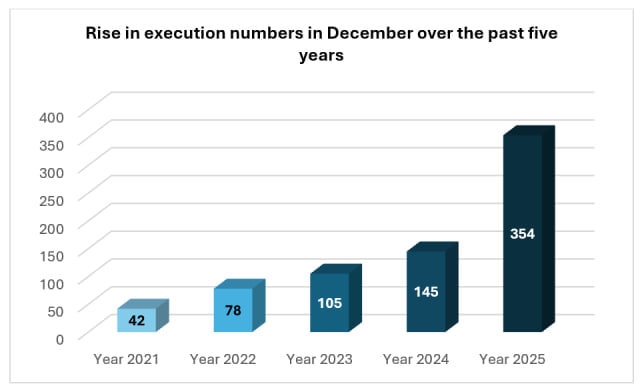
The execution statistics for the month of December over the past five years reveals a continuous and sharply escalating upward trend. The number of executions rose from 42 cases in December 2021 to 354 cases in December 2025 — representing an increase of approximately 743% over a five-year period.
In other words, the number of executions recorded in December 2025 was more than eight times higher than in December 2021.
From 20 March 2025 to 20 December 2025, at least 1,822 prisoners were executed in various prisons across the country. In comparison, during the same period in 2024, the recorded number of executions stood at 960 cases.
3- Geographic Distribution of Executions
In December 2025, executions were recorded across a wide geographical area of the country, in at least 67 different cities. This breadth demonstrates that the cycle of executions has become a nationwide and routine practice within the structure of repression of the Islamic Republic.
Among these locations, Shiraz recorded the highest number of executions. Karaj with two active prisons, ranked second. Executions in Karaj are carried out in Qezel Hesar Prison and Central Karaj Penitentiary.
Although, following the widespread hunger strike by prisoners in Qezel Hesar last month, the implementation of death sentences related to drug offences was temporarily suspended, executions of prisoners accused of murder in the same prison have increased at an alarming pace. In just one month, 20 prisoners were executed in Qezel Hesar alone—a figure that has effectively turned the prison into a killing ground for prisoners.
The geographical distribution of executions, indicates that after Shiraz and Karaj, the cities of Isfahan, Rasht, and Khorramabad rank next and account for a significant proportion of executions in the past month. This pattern reflects a concentration of executions in specific provinces that play a central role in the government’s execution-centred policy.
4- Systematic Concealment and Lack of Transparency
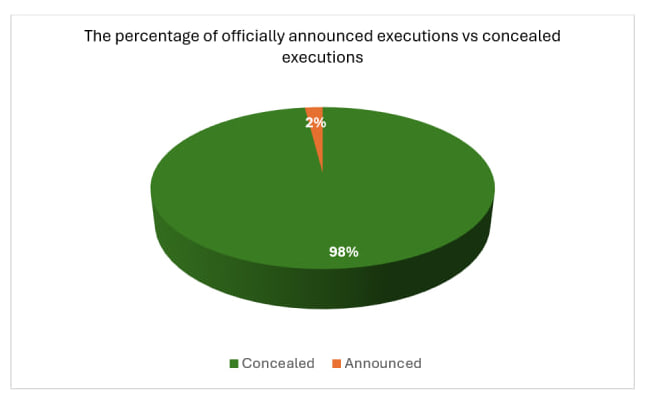
The ratio between officially announced executions and concealed executions in the past month reveals the depth of the crisis of transparency and accountability within the judicial system of the Islamic Republic.
Out of a total of 354 recorded executions during the month, only 8 cases — equivalent to less than 3% — were announced by state media or official government sources. In contrast, the remaining 346 cases, representing more than 97% of executions, were documented not through official channels but through disclosures by human rights activists, citizen journalists, and prisoners’ families, and were recorded by the Prisoners’ Rights League in Iran.
This stark statistical gap demonstrates that concealment is not an exception but rather an organised and systematic practice in the implementation of the death penalty. The failure to officially announce the overwhelming majority of executions reflects a deliberate effort by the authorities to manage the social and international consequences of prisoner killings, to reduce public sensitivity, and to prevent the emergence of protest movements.
Under these conditions, the judiciary has effectively evaded even the minimum requirements of transparency and accountability, systematically violating the right of families and society to be informed. From a human-rights perspective, this level of secret executions constitutes the simultaneous violation of several fundamental principles of international law, including the right to access information, the right to a fair trial, the prohibition of inhuman and degrading treatment, and the right of families to know the fate of their loved ones.
The concealment of executions also facilitates further violations, such as secret burials, the withholding of bodies, and the removal of victims’ names from official records, thereby reinforcing impunity for perpetrators.
Overall, more than 97% of executions were disclosed exclusively through independent sources. This demonstrates that execution statistics in Iran are effectively kept hidden from the public, a situation that increases the responsibility of the international community to take independent, urgent, and effective action in response to this widespread and systematic violation of the right to life.
The chart below illustrates the ratio of officially announced to concealed executions:
5- Execution of Women and Juvenile Offenders
According to the Statistical Centre of the Prisoners’ Rights League in Iran, in the past month at least 10 women were executed in various prisons across the country. With these cases included, the total number of women executed between 20 March and 20 December 2025 reached 60 individuals — a figure that represents an increase of more than 58% compared with the total of 38 women executed during the previous year.
This sharp rise reflects a deeply concerning escalation in the use of the death penalty against women and indicates a widening gender gap within the criminal justice system of the Islamic Republic.
Breakdown of charges against executed women in the past month
- Murder charges — 7 cases
During the past month, seven women prisoners were executed on murder charges in the prisons of Mashhad, Tabriz, Urmia, Qom, Qezel Hesar, and Hamedan. The identities of these prisoners are:
Mahin Rahimi, Elnaz Habibi, Rana Farajoghli, Sedigheh Ghorbani, Hamideh Jabbari (41), Razieh Abbasi (40), and Mahdieh Keyhani (42).
The case of Rana Farajoghli, in particular, reveals deeper dimensions of structural violence against women. She was forcibly married at the age of 16 in the context of child marriage to a man 19 years older, who already had three children from a previous marriage. Such cases demonstrate how the judicial system, without considering the social context of domestic violence, coercion, gender inequality, and the absence of legal protections, prosecutes and punishes women solely as perpetrators of crime.
- Drug-related offences — 3 cases
In the same month, three women prisoners were executed on charges related to drug offences in the prisons of Shiraz and Mashhad. The identities of these prisoners are Mina Sadeghi (41), Mahin Rashidi (39), and one woman whose identity remains unknown.
These cases once again demonstrate that women—particularly under conditions of poverty, marginalisation, and lack of social support—are disproportionately victimised by harsh and ineffective punitive policies, especially in the area of drug-related offences. These are policies that, instead of adopting treatment-based and supportive approaches, are fundamentally built on the death penalty.
The sharp increase in the execution of women in the current year is not an accidental phenomenon, but rather the result of a convergence of violent punitive policies, structural gender discrimination, and the collapse of social support systems. In most of these cases, clear indicators of unfair trials, lack of effective access to an independent lawyer, disregard for histories of domestic violence, child marriage, coercion, and conditions of social inequality are evident.
This situation constitutes a clear violation of Iran’s international obligations, including the right to life, the principle of proportionality between crime and punishment, the prohibition of gender-based discrimination, and the obligation to provide special protection to women exposed to violence.
6- Ethnic Minorities and Structural Discrimination
Recorded statistics indicate that at least 18 executed prisoners belonged to ethnic minorities, including 12 Kurdish prisoners and 6 Baluch prisoners. This unequal distribution once again highlights the discriminatory practices and ongoing securitisation of ethnic minorities in Iran.
In addition, seven Afghan nationals and two Iraqi nationals were among those executed. This raises serious concerns regarding the lack of fair trial guarantees for foreign nationals, including the absence of access to interpreters and legal counsel, and the heightened vulnerability of migrants.
7- Public Executions
In the past month, at least three prisoners were executed in public. Two executions took place in Semnan, one of whom has been identified as Mostafa Ajdani, and one execution was carried out in Borazjan, where a prisoner named Mohammad Zakari was hanged.
The implementation of three public executions within a single month is unprecedented since the 1980s and signals a return to the overt display of state violence.
8 – Issuance and Confirmation of Death Sentences
In the past month, death sentences were issued for at least eight defendants, and the death sentences of five additional prisoners were upheld by the Supreme Court. Of the total death sentences issued or confirmed:
- Eight cases concerned political prisoners;
- Nine cases involved defendants in murder cases, including one woman; and
- One case related to a rape charge.
Among the political prisoners sentenced to death, Karim Khojasteh was convicted of baghi (armed rebellion) through alleged membership in the People’s Mojahedin Organization of Iran by Branch One of the Rasht Revolutionary Court, presided over by Judge Ahmad Darvish.
Additionally, Pouya Ghobadi, Vahid Bani Amerian, Babak Alipour, Mohammad Taghi Sangdehi, Akbar Daneshvarkar, and Abolhassan Montazer were once again sentenced to death on charges of baghi through alleged membership in the same organisation by Branch 26 of the Tehran Revolutionary Court, presided over by Judge Iman Afshari.
Ramin Zelleh was also sentenced to death on charges of baghi through alleged membership in the Kurdistan Democratic Party of Iran by Branch One of the Mahabad Revolutionary Court, presided over by Judge Ahad Siamy.
Furthermore, the death sentences of two political prisoners—Mohammad Javad Vafaei Sani, convicted of arson and destruction of specific public buildings and alleged links to the People’s Mojahedin Organization of Iran, and Mehrab Abdollahzadeh, convicted of efsad-e fel-arz (corruption on earth) and participation in the killing of a Basij member—were upheld by the Supreme Court, along with three other defendants in murder cases.
This pattern demonstrates the continued use of the death penalty by the judiciary, particularly against political opponents, without adherence to fair trial standards.
9- Flogging Sentences
In the past month, flogging sentences were issued for 13 defendants. Of these, the flogging sentences of 11 defendants accused of disrupting the pharmaceutical system were upheld by the West Azerbaijan Province Court of Appeal, although the number of lashes imposed was not specified.
In addition, Nima Ashrafzadeh, CEO of Pindo, a subsidiary of Digikala, was sentenced to 74 lashes on charges related to organising a mixed-gender Yalda Night celebration and the alleged failure to observe compulsory hijab by several women.
Another defendant was sentenced to 148 lashes on charges of arson, violence against the victim, and theft.
Flogging constitutes a clear form of corporal and degrading punishment, inherently violating human dignity, and is absolutely prohibited under Article 5 of the Universal Declaration of Human Rights and Article 7 of the International Covenant on Civil and Political Rights, which ban torture and cruel, inhuman, or degrading treatment or punishment.
The continued issuance of such sentences amounts to the legalisation of torture within the judicial system of the Islamic Republic and represents a blatant violation of Iran’s international obligations.
10- Wave of Arrests
In the past month, at least 183 citizens were arrested for political, ideological, or ethnic reasons, for participating in the funeral ceremony of Dr Khosrow Alikordi (a lawyer), or for expressing their views on social media.
Those arrested include former political prisoners, families seeking justice, political and civil activists, media workers, artists, Baha’i citizens, and participants in protest gatherings.
According to police news agency reports, 14 citizens were arrested for writing slogans or distributing or installing critical banners and were accused of having links with foreign entities. In addition, the Head of the Judiciary of Mazandaran Province announced the arrest of 11 members of a Telegram channel on charges of disrupting national security.
In other cases, commanders of the IRGC and law enforcement agencies reported the arrest of citizens on charges of setting fire to government buildings or writing slogans — allegations that are often made without transparent evidence.
11- Incidents Inside Prisons
In the past month, at least seven prisoners, including one prisoner of conscience, died in various prisons across the country. The primary causes of these deaths have been reported as delays in medical care, lack of access to adequate treatment facilities, psychological pressure, and inhuman prison conditions. The recorded cases include deaths in the prisons of Bukan, Ahvaz, Kermanshah, Babol, Mashhad, Mahabad, and Salmas. These incidents constitute clear violations of the right to life and reflect the direct responsibility of the authorities to safeguard the lives of prisoners.
12- Judicial Convictions and Enforcement of Sentences
During the past month, judicial sentences were issued against 32 prisoners in cases related to political and ideological charges, amounting in total to 172 years, 6 months, and 27 days of imprisonment, as well as 538,100,000 tomans in fines. In addition, seven political and ideological prisoners were arrested for the enforcement of previously issued sentences.
Those convicted include political activists, families seeking justice, students, journalists, artists, ethnic activists, Baha’i citizens, Christian converts, and social media users.
13- Labour-Related Incidents
In the past month, due to the lack of adequate safety measures and oversight, 45 workers lost their lives and 97 other workers were injured. The main causes of these incidents were reported to be the absence of standard safety equipment, lack of training, and employer negligence.
During the same month, more than 44 workers were dismissed from their jobs, including workers at Petronad Petrochemical Company in Mahshahr, Hoveyzeh, Makran Agro-Industrial Company in Konarak, and the Darougar pharmaceutical factory. These dismissals were often carried out without transparent justification and in violation of workers’ fundamental rights.
14- Escalation of Violence Against Women
In the past month, 21 women were killed as a result of gender-based violence. Most of these killings were registered under the vague label of “family disputes” — an approach that obscures the structural nature of violence against women.
An examination of these cases shows that the killings occurred within a context of legal discrimination, gender inequality, lack of legal protections, and the ineffectiveness of preventive mechanisms, and constitute grave violations of women’s right to life and human dignity.
15- Protests and Strikes
In the past month, more than 430 protests and collective actions were held across different parts of the country. The “Tuesdays Against Execution” campaign reached its 99th week, with political and ideological prisoners in 55 prisons staging hunger strikes in protest against widespread violations of their fundamental rights.
At the same time, families of political prisoners held weekly gatherings demanding a halt to execution sentences.
Widespread protests by retirees, oil and gas workers, and other segments of society also continued in response to poverty, discrimination, violations of labour rights, and official indifference.
Conclusion
The present report demonstrates that December marked one of the darkest periods of human rights violations in Iran. The implementation of at least 354 executions, the majority of which were carried out in secrecy, reflects the systematic use of the death penalty as a tool of political and social repression.
The judiciary has played a central role in violating the right to life, the right to a fair trial, and human dignity. In contrast, the continued popular protests, hunger strikes by political prisoners, and the civil resistance of families seeking justice reflect the deep rift between society and the ruling authorities, as well as the ongoing demand for justice and the right to life.