
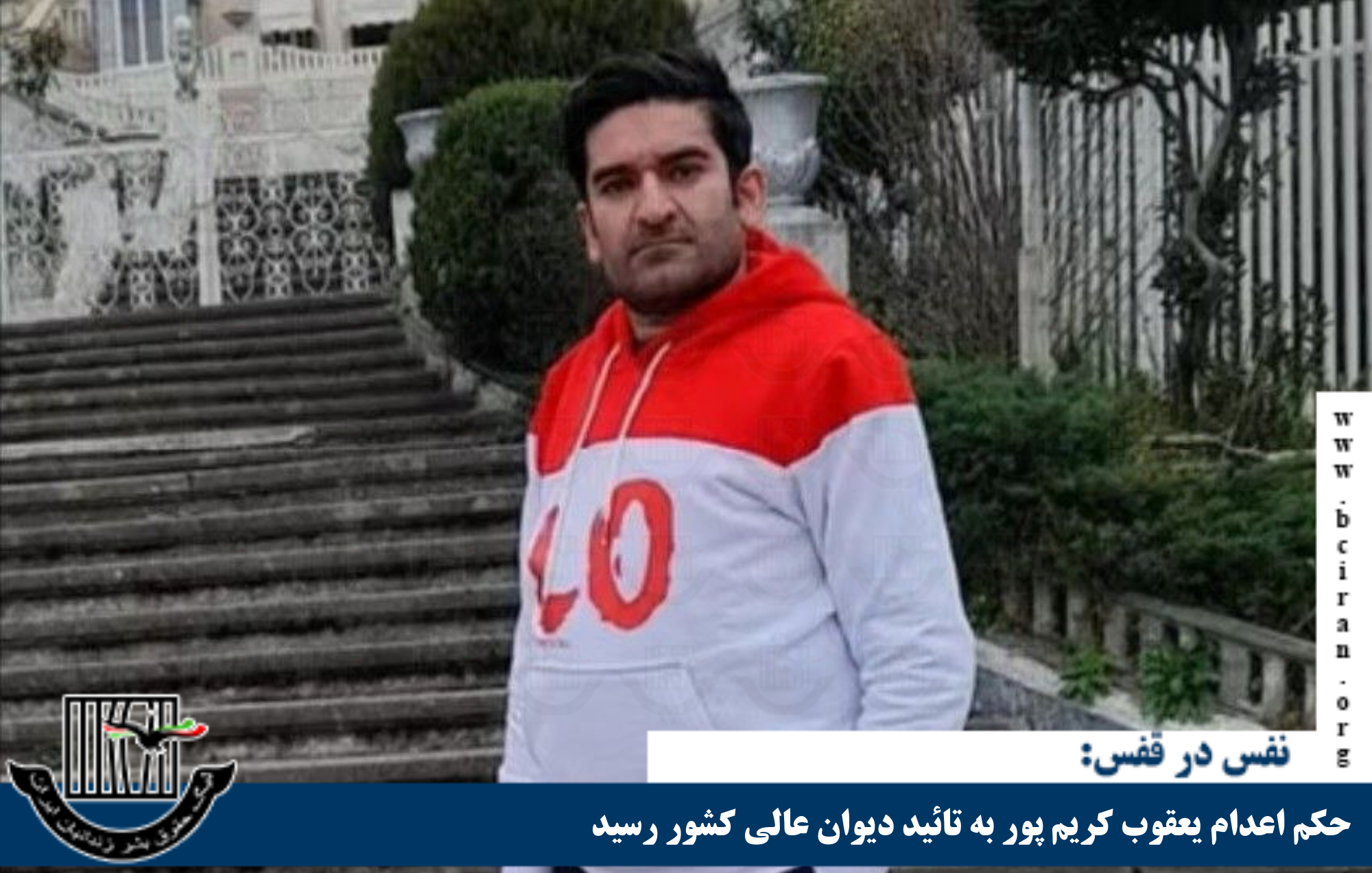
Death Sentence of Yaqub Karimpour Upheld by the Supreme Court
13-February-2026
Category: Prisoners
12 February 2026
News Group: Prisoners –
Breathing in Confinement – The death sentence of Yaqub Karimpour, a security prisoner held in Urmia Prison, has been upheld by the Supreme Court.
According to Breathing in Confinement, the news outlet of the Prisoners’ Rights League in Iran, the death sentence of Yaqub Karimpour, a follower of the Parsan faith, was upheld by Branch 9 of the Supreme Court and was officially communicated to him on Tuesday, 10 February 2026.
Yaqub Karimpour, 41, a law graduate, was arrested by security forces in June 2025. According to received reports, during his detention he was subjected to severe physical and psychological pressure and was forced to make coerced confessions—confessions which, under the fundamental principles of fair trial, lack legal validity and judicial credibility.
In December 2025, he was sentenced to death by Branch One of the Urmia Revolutionary Court, presided over by Judge Sajad Dousti, on the charge of “corruption on earth through espionage for Israel.” The judicial process in his case was accompanied by serious violations of the principles of a fair trial. No report has been published regarding a request for retrial in his case.
Based on available information, Mr Karimpour was deprived of the right to family visits during his detention and was also denied access to a lawyer of his own choosing until the court proceedings. These practices are in clear contradiction with Article 35 of the Constitution of the Islamic Republic of Iran, Article 14 of the International Covenant on Civil and Political Rights (to which Iran is a state party), and other international standards of fair trial.
Furthermore, the use of confessions obtained under pressure or torture constitutes an explicit violation of the prohibition of torture and cruel, inhuman, or degrading treatment—a principle firmly established in both domestic and international law. The issuance and confirmation of a death sentence under such circumstances raise serious concerns regarding the right to life, the right to a fair trial, and the presumption of innocence.