
Annual Report on Human Rights Violations in Iran – 2025 (1404)
12-April-2026
Category: Uncategorized
12/04/2026
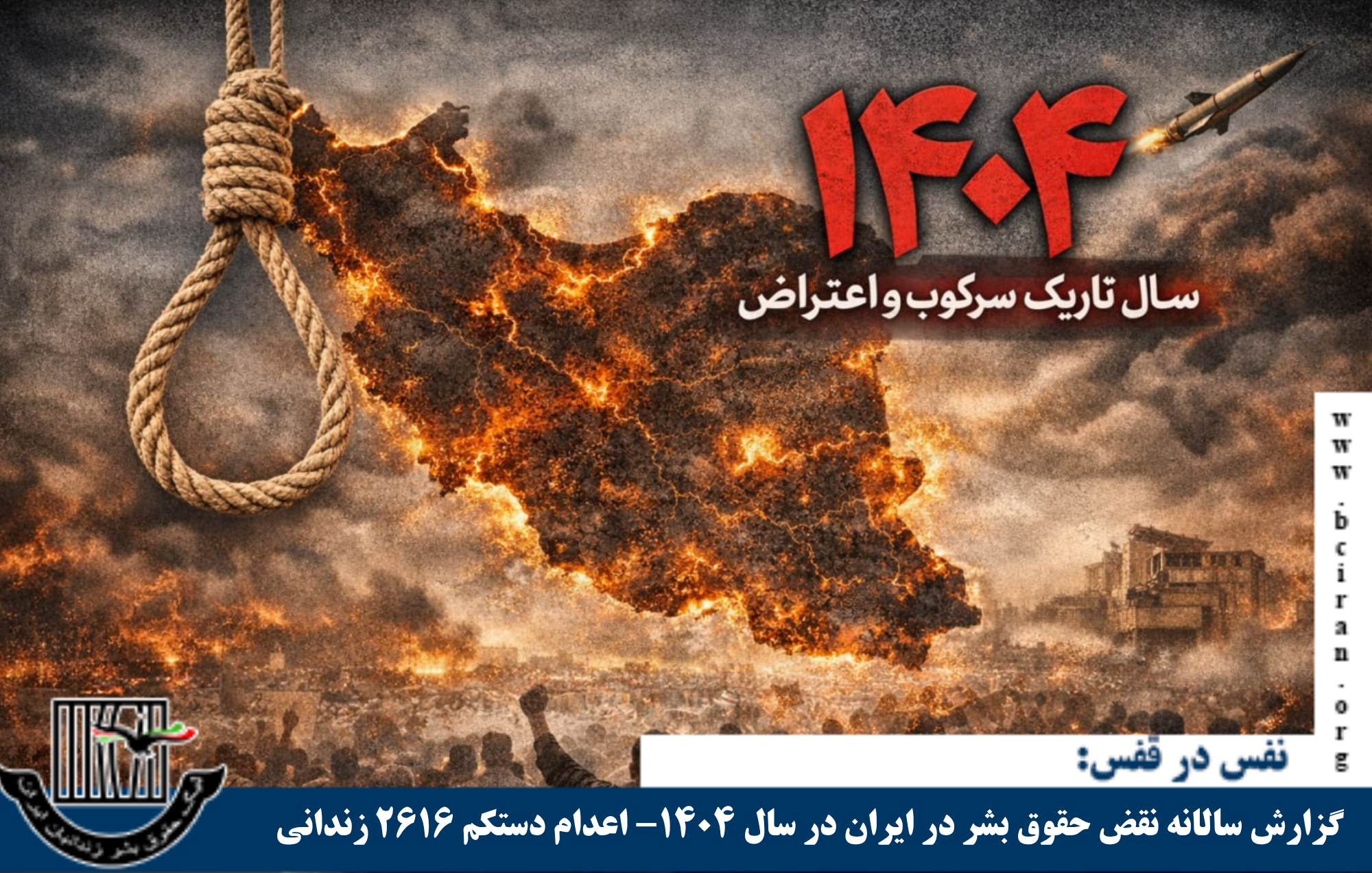
Breathing in Confinement:The statistical centre of the Prisoners’ Rights League in Iran publishes its annual report on human rights violations for 2025 (20 March 2025 to 20 March 2026).
Summary
Death Penalty
- At least 2,616 executions were carried out, including 35 political and ideological prisoners.
- Death sentences were issued for 107 prisoners.
- Death sentences of 43 individuals were upheld.
Arrests and Prison Conditions
- At least 9,463 citizens were arrested.
- At least 6 individuals were killed under torture in detention centres and prisons.
- At least 40 prisoners died due to lack of medical care and negligence by prison authorities.
- 4 prisoners died by suicide as a result of pressure and conditions in detention.
Corporal Punishment
- Flogging sentences were issued for 70 individuals.
- A total of more than 3,353 lashes were sentenced.
- Amputation of fingers was carried out for 4 individuals.
- Similar sentences were issued for 4 additional individuals.
Prison Sentences and Fines
- Sentences were issued for 342 political, ideological, and ethnic defendants.
- 105 individuals were detained to serve their sentences.
- Total fines amounted to 7,023,800,000 tomans.
Workplace Incidents
- 546 workers lost their lives.
- At least 3,742 workers were injured in workplace accidents.
Violence Against Women
- 129 cases of killings related to violence against women were recorded.
Protests and Civic Movements
- More than 5,000 protests and collective actions were held.
- The campaign “Tuesdays Against Execution” continued in 56 prisons nationwide.
- Families of political prisoners continued gatherings in protest against death sentences.
- Ongoing protests by retirees and other social groups persisted.
Introduction
The Persian year 1404 (20 March 2025 – 20 March 2026) came to an end. It was a year that, from the perspective of widespread and systematic human rights violations—particularly in the implementation of the death penalty—has been recorded as one of the bloodiest years in Iran’s contemporary history since the 1980s.
According to the documented data collected, at least 2,616 individuals were executed during this year. This figure represents an increase of more than 120% compared to the 1,170 cases recorded in the previous year.
Given the severe limitations in access to information, including repeated and prolonged internet shutdowns, this figure is likely an underestimation of the true number of executions.
Alongside this escalating trend of executions, in January 2026, a wave of nationwide protests emerged in response to the deepening economic crisis, including the collapse of the national currency, rising exchange rates, rampant inflation, and widespread price increases.
These protests, which began with a strike in Tehran’s Grand Bazaar, quickly spread to other cities and regions across the country, evolving into a nationwide uprising against the ruling establishment.
The authorities’ response, however, was widespread, organised, and violent repression. Simultaneously with a complete internet shutdown on 8 and 9 January, numerous reports of mass killings of protesters were published, indicating that thousands of citizens lost their lives.
Additionally, reports were documented of attacks on medical centres and the targeting of injured individuals within hospitals.
In addition, during the past year, two major military confrontations took place, the direct consequences of which were borne by civilians. The first was the 12-day conflict between the Islamic Republic and Israel, and the second involved aerial clashes between the Islamic Republic, Israel, and the United States.
These confrontations, in addition to resulting in the deaths of several senior officials and military commanders, led to the deaths of hundreds of civilian citizens and caused extensive damage to public infrastructure, residential homes, and educational facilities.
Overall, the past year can be assessed as one of the darkest periods in terms of widespread, systematic, and escalating human rights violations in Iran.
This report, with a particular focus on the situation of prisoners and the use of the death penalty, seeks to present a comprehensive and evidence-based picture of the scale of this crisis through documented data and trend analysis.
In the following sections, the report first examines the five-year trend of human rights violations, particularly executions. It then provides detailed monthly statistics for the past year, followed by a monthly analysis of trends over the five-year period.
The human rights organisation the Prisoners’ Rights League in Iran emphasises the necessity of accountability and calls upon international bodies, including international judicial institutions, to utilise existing legal mechanisms to end the impunity of those responsible for these violations.
Furthermore, all international organisations are urged to take practical and effective measures to halt this deeply concerning trend.
Comparison of Execution Statistics Over the Past Five Years
An examination of the use of the death penalty by the authorities of the Islamic Republic over the past five years reveals a concerning and escalating pattern in the application of this instrument of repression.
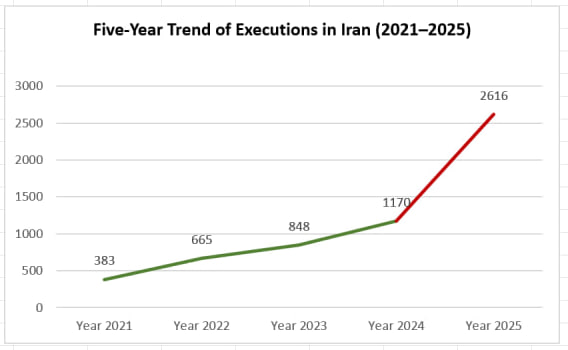
Documented data indicate that the number of executions has steadily increased from 383 cases in 2021, rising to 665 cases in 2022 and 848 cases in 2023. This upward trend entered a new phase in 2024, with 1,170 executions recorded.
However, the peak of this increase occurred in 2025, when the number of executions rose unprecedentedly to 2,616 cases.
This trend reflects not only a quantitative increase, but also a qualitative escalation in the use of the death penalty as a tool of social and political control. In particular, the sharp rise between 2024 and 2025, during which the number of executions more than doubled, indicates the emergence of a new phase of intensified systematic repression.
The line graph presented in this section clearly illustrates this upward trajectory, demonstrating how, over the past five years, the death penalty has increasingly become one of the regime’s primary tools for managing internal crises, suppressing social protests, and creating a climate of fear within society.
Executions by Year
- 2021: 383 cases
- 2022: 665 cases
- 2023: 848 cases
- 2024: 1,170 cases
- 2025: 2,616 cases
In the following sections, this trend will be examined in greater detail, including its relationship with the country’s political, social, and security developments.
Analysis of data published by the statistical centre of the Prisoners’ Rights League in Iran indicates that in 2025, the wave of executions in Iran reached an unprecedented and deeply alarming level. At least 2,613 prisoners were executed in various prisons across the country.
The majority of these executions were related to:
- Murder charges: 1,393 cases
- Drug-related offences: 1,106 cases
However, alongside these, the sharp increase in political and ideological executions, with 35 cases compared to only 7 in the previous year, represents a rise of more than 500%, highlighting the growing use of the death penalty as a tool of political repression.
Additionally, the recording of 15 executions on espionage charges, compared to none in the previous year, indicates a significant intensification of the country’s security and judicial climate.
Out of the 2,616 recorded executions, only 101 cases were officially announced by state media and government sources, while the remaining 2,515 cases were documented by human rights activists, families, and citizen journalists. This gap clearly reflects a structural lack of transparency in official reporting.
The presence of 67 women, 8 juvenile offenders, and 10 public executions within these figures adds further gravity to the situation. It demonstrates that the use of the death penalty has reached a critical stage, not only in quantitative terms but also in terms of violations of fundamental human rights principles, fair trial standards, and Iran’s international obligations.
Analysis Based on the Characteristics of Executed Individuals
Women
In 2025, at least 67 women were executed in various prisons across the country. This represents an increase of more than 120% compared to 30 cases in the previous year.This significant surge reflects a deeply concerning escalation in the use of the death penalty against women during the past year and reveals new dimensions of human rights violations within Iran’s judicial system. The increasing number of women executed, in addition to reflecting the overall upward trend in executions, underscores the urgent need for greater scrutiny of women’s treatment in judicial proceedings, their access to fair trial guarantees, the quality of legal representation available to them, and the social and legal contexts surrounding their cases.
This trend also highlights the necessity for more precise documentation, greater transparency, and a serious response from international human rights bodies regarding the situation of women prisoners in Iran.
Notable Cases of Political Executions
April 2025
- Malik Ali Fadaei Nasab
- Farhad Shakeri
- Abdolhakim Azim Gorgij
- Abdolrahman Gorgij
- Taj Mohammad Kharmali
- Ali Dehani
May 2025
- Hamid Hosseinnejad Heydaranlou (secretly executed in Urmia Prison)
- Rostam Zeinoddini (Hajigol) – Zahedan Prison
June 2025
- Mojahid Korkor (Abbas Korkori), one of those arrested during the 2022 uprising
- One ideological prisoner executed on charges of enmity against God (moharebeh) through armed action and membership in ISIS
August 2025
- Behrouz Ehsani Eslamloo – charged with armed rebellion (baghi), moharebeh, and membership in the Mojahedin-e Khalq Organisation
- Mehdi Hassani – charged with armed rebellion (baghi), moharebeh, and membership in the Mojahedin-e Khalq Organisation
- Mehdi Asgharzadeh, a Sunni ideological prisoner – charged with membership in ISIS
September 2025
- Mehran Bahramian, one of those arrested during the 2022 nationwide protests
- One ideological prisoner charged with membership in ISIS (identity unknown)
October 2025
- Saman Mohammadi Khiari – charged with moharebeh through membership in opposition groups and the assassination of Mamosta Sheikh al-Islam
- Ali Mojdam – charged with moharebeh through membership in armed groups and killing four officers
- Moein Khanfari – charged with moharebeh through membership in armed groups and killing four officers
- Seyed Salem Mousavi – charged with moharebeh through membership in armed groups and killing four officers
- Mohammadreza Moghadam – charged with moharebeh through membership in armed groups and killing four officers
- Adnan Albooshokeh (Ghobishavi) – charged with moharebeh through membership in armed groups and killing four officers
- Habib Darist – charged with moharebeh through membership in armed groups and killing four officers
February 2026
- Amanj Karvanchi – executed on ideological charges
- Arsalan Sheikhi – executed on ideological charges
March 2026
- Mehdi Ghasemi – one of those arrested during the January 2026 uprising
- Saleh Mohammadi – one of those arrested during the January 2026 uprising
- Saeed Davoudi – one of those arrested during the January 2026 uprising
Concealment of Executions
Of the 2,616 executions recorded during the past Persian year, only 101 cases—less than 4%—were announced by official state media and government sources. This means that more than 96% of executions were carried out in complete silence, accompanied by deliberate and organised concealment, and were exposed only through the persistent efforts of human rights organisations, victims’ families, and citizen-journalist networks.
Such a profound gap between official statistics and independently documented data not only reflects the structural lack of transparency within Iran’s judicial and prison systems, but also demonstrates that the concealment of executions has become part of the state’s broader mechanism of repression and impunity.
This level of secrecy severely restricts public oversight, access to truth, and the ability to assess compliance with minimum fair-trial standards, thereby underscoring the urgent need for international attention to Iran’s systematic concealment of executions.
Issuance and Confirmation of Death Sentences
During the past year, the issuance and confirmation of death sentences—like the implementation of executions themselves—reached deeply concerning and widespread levels.
According to recorded data:
- Death sentences were issued for at least 107 defendants
- The death sentences of 43 additional prisoners were upheld by the Supreme Court
These figures indicate the continued and entrenched use of capital punishment within the judicial structure of the Islamic Republic.
Among these individuals, the presence of 50 political and ideological prisoners, including one female political prisoner, is of particular significance and reflects the expanding use of the death penalty in cases linked to political activity, ideological beliefs, and opposition to the state.
In addition:
- Five other women were sentenced to death on various charges
- Nine defendants faced death sentences on espionage-related charges
This suggests an intensification of the security-oriented judicial approach toward political and security-related defendants.
These statistics demonstrate that the issuance of death sentences during the past year was not limited to ordinary criminal offences, but also encompassed a broad range of political, ideological, and security-related accusations.
This trend further highlights the need for stricter scrutiny of compliance with fair-trial principles, the right to independent legal representation, and the prevention of the instrumentalisation of capital punishment.
Flogging Sentences
During the past year, flogging continued to be widely used as a punitive measure within the judicial system of the Islamic Republic.
At least 70 defendants were sentenced to a combined total of 3,353 lashes.
However, the implementation status of flogging sentences for nine convicted individuals—including members of the Sardasht City Council convicted on bribery-related charges—remains unclear, once again highlighting the issue of opacity in the enforcement of punishments.
Among those sentenced were eight political defendants, two of whom—Atash Karami and Reza Rezaei—had their flogging sentences carried out.
This demonstrates that flogging is employed not only in ordinary criminal cases, but also against political activists and politically charged defendants.
As a form of corporal and degrading punishment, flogging is inherently incompatible with human dignity and, under international human rights law, may constitute cruel, inhuman, or degrading treatment or punishment.
The continued issuance and implementation of flogging sentences—despite Iran’s international obligations under foundational instruments such as the Universal Declaration of Human Rights and the International Covenant on Civil and Political Rights—raises serious concerns regarding proportionality of punishment, observance of fair-trial principles, and the judiciary’s adherence to minimum human rights standards.
Amputation of Fingers
During the past year, the issuance and implementation of amputation sentences continued as one of the harshest forms of corporal punishment in the judicial system of the Islamic Republic.
In this period:
- The amputation of four fingers of the right hand was carried out against three prisoners—Hadi Rostami, Mehdi Sharafian, and Mehdi Shahivand—in Urmia Central Prison
- Mohsen Ashouri, a 37-year-old resident of Zazaran, Isfahan Province, was subjected to a similar sentence in Isfahan Central Prison
In addition to those carried out, four defendants in the case known as the “Northern Tehran Spider Thieves Gang” were sentenced by Branch Eight of Tehran Province Criminal Court One to amputation of the fingers of the right hand on theft charges.
The continued issuance and implementation of such punishments demonstrates that irreversible corporal punishments remain part of Iran’s formal penal system.
From the perspective of many human rights organisations and international legal experts, amputation constitutes one of the clearest examples of cruel, inhuman, and degrading punishment, fundamentally incompatible with the principle of inherent human dignity.
The irreversible and lifelong nature of this punishment not only inflicts profound physical and psychological harm on the convicted individual, but also raises serious questions regarding proportionality of punishment, prospects for rehabilitation, and the judiciary’s adherence to recognised human rights standards.
Wave of Arrests
During the past Persian year, more than 9,463 citizens were arrested for political reasons, particularly for participating in nationwide protests. However, human rights sources have estimated that the number of arrests related to the January 2026 protests alone exceeded 50,000 individuals.
Those targeted in this wave of repression included:
- Former prisoners
- Political activists
- Participants in nationwide protests
- Media and social media activists
- Artists
- Trade and professional groups
- University students
- School students
- Teachers
- Workers and retirees
- Ethnic activists
- Baha’i citizens
- Christian converts
According to human rights sources, more than 50,000 individuals were arrested for participating in the nationwide protests that began on 28 February, initiated by market strikes in response to inflation and the collapse of the national currency.
This demonstrates the extensive scale of repression and the use of mass arrests as a tool to suppress public dissent.
Prison Incidents
During the past Persian year, reports revealed deeply alarming conditions in Iranian prisons.
At least:
- 4 prisoners died as a result of torture
- Approximately 40 prisoners died due to delayed transfer to medical facilities or lack of medical care
- 6 prisoners died by suicide as a result of harsh conditions, psychological pressure, and lack of access to mental health services
These figures present a deeply troubling picture of violations of the rights to life, health, and human dignity within Iran’s detention facilities, and demonstrate that denial of medical care and structural pressures have themselves become mechanisms of killing prisoners.
Within this context, the situation of prisoners with chronic or serious medical conditions is particularly concerning.
For example, political prisoner Somayeh Rashidi, who suffered from epilepsy and severe headaches, died after approximately 10 days in a deep coma at Mofatteh Hospital in Varamin. Her death followed delayed transfer to hospital and the replacement of her specialist medications with sedatives.
Such cases highlight the urgent need for attention to medical standards, the right of access to specialist healthcare, and the protection of patients’ rights in detention.
Prison Protests and Resistance
Among other notable developments was the continuation of the hunger strike campaign known as “Tuesdays Against Execution” across 56 prisons nationwide.
In addition, prisoners engaged in gatherings, protests, chanting of protest slogans, and collective singing of protest songs during various occasions.
These actions demonstrate the resistance, resilience, and ongoing efforts of prisoners to pursue their demands despite security pressures, and show that prisoners continue to use peaceful forms of protest to make their voices heard.
Another significant event of the past year was the hunger strike and sit-in by prisoners in Qezel Hesar Prison protesting the implementation of death sentences, particularly in drug-related cases.
These prisoners demanded, among other things:
- A halt to executions
- Reduction of sentences
The strike ultimately ended after continued protests and following promises by authorities of a temporary suspension of executions, as well as the return of prisoners transferred to solitary confinement for execution back to the general prison wards.
This protest movement was also supported by political prisoners and became one of the most notable symbols of civil resistance within prisons during the past year.
Judicial Convictions and Enforcement of Sentences
During the past year, judicial sentences were issued in 342 cases involving political, ideological, and ethnic defendants, and 105 convicted individuals were arrested for enforcement of their sentences.
Total Prison Sentences Issued
- 1,125 years, 2 months, and 25 days of imprisonment
Total Monetary Fines
- 7,023,800,000 tomans
Additionally, 105 political, ideological, ethnic defendants, Baha’i citizens, and Christian converts were detained for enforcement of judicial sentences.
Those convicted included:
- Political activists
- Political prisoners facing new charges while already imprisoned
- Families seeking justice
- Students
- Journalists
- Writers
- Artists
- Sunni and Shia clerics
- Ethnic activists
- Baha’i citizens
- Christian converts
Labour Incidents
Due to inadequate safety measures, 546 workers lost their lives in workplace incidents last year, while 3,742 others were injured.
The main causes of these incidents include:
lack of standard safety equipment,
insufficient training and supervision,
and employer negligence.
According to a deputy at the Ministry of Health, around 10,000 people die annually in Iran as a result of workplace accidents. However, official statistics record just over 2,000 deaths per year. This discrepancy points to a serious gap between official data and the reality of workplace conditions.
These figures reflect only part of the true scale of the workplace safety crisis in Iran. Importantly, many high-risk groups — including informal workers, kulbars (cross-border porters), and fuel carriers — are excluded from official statistics. As a result, the actual number of work-related deaths and injuries is likely far higher than reported. This situation highlights the urgent need for stronger safety standards, effective inspections, employer accountability, and greater protection for vulnerable workers.
Violence Against Women
Last year, at least 129 women lost their lives as a result of fatal acts of violence — a shocking figure that reveals the alarming scale of violence against women in Iran. The reasons cited for these killings are often described by perpetrators or those around the victims using vague and general terms such as “family disputes” or “honour-related issues.” Such labels not only obscure the reality of these crimes, but also contribute to the normalisation of violence, conceal its structural causes, and deflect legal and social responsibility, thereby preventing a full understanding of the problem.
Closer examination shows that many of these killings occurred in the context of economic hardship, cultural restrictions, gender inequality, and legal and institutional gaps in protection. The lack of sufficiently deterrent laws, ineffective enforcement of existing regulations, and women’s limited access to meaningful support mechanisms are among the factors that enable such violence to recur.
In a significant proportion of cases, women were killed by those closest to them — individuals who would ordinarily be expected to provide safety and support. Yet these cases are often recorded without serious investigation and merely categorised as “family disputes,” a label that can obscure patterns of violence and hinder efforts to prevent future abuse.
The recurrence of such incidents demonstrates the urgent need to establish and strengthen support structures for women at risk, including safe houses, support hotlines, access to specialist counselling, and social services, alongside reform and effective enforcement of laws relating to domestic violence and gender-based killings. Increasing public awareness through education on violence prevention and challenging discriminatory cultural attitudes can also play a decisive role in reducing such cases. Without these measures, the cycle of violence against women and the reproduction of these crimes will continue.
Protests and Strikes
During the past year, Iran’s social and political landscape witnessed more than 5,000 gatherings and protest actions across the country, a figure reflecting the continued and expanding public discontent among various sectors of society.
During the same period, the campaign “Tuesdays Against Execution” approached its second year of activity and became one of the most enduring and widespread forms of civil protest in the field of human rights and opposition to the death penalty.
The past year also saw a widespread and unprecedented popular uprising rooted in the worsening economic crisis, the unprecedented collapse of the national currency, and the uncontrolled surge in exchange rates. These developments, combined with rising inflation and the severe decline in purchasing power, placed immense pressure on the livelihoods of broad segments of society and fuelled public anger.
In this context, widespread strikes by merchants and shopkeepers—particularly in Tehran, marked by shop closures and suspension of economic activity—emerged as one of the most visible manifestations of protest.
Through these protest actions, demonstrators voiced their anger, concern, and deep mistrust regarding the deteriorating economic conditions, market instability, and uncertainty about the future.
The protests rapidly spread beyond urban centres to other parts of the country. The swift emergence of overtly political slogans reflected the deepening divide between sections of society and the governing establishment, and indicated growing demands for fundamental changes in governance.
In response, the authorities adopted a security-oriented approach, implementing widespread nationwide internet shutdowns in an effort to prevent information dissemination and coordination among protesters.
At the same time, on 8 and 9 January, violent repression reached its peak, with security forces opening direct fire using live ammunition, resulting in the mass killing of protesters.
According to documented reports, a number of injured protesters were also shot by security forces inside medical centres and hospitals, leading to their deaths—an incident that raised serious concerns regarding violations of basic human rights principles and the inviolability of medical facilities.
Prisoner and Family Protests
Another significant protest-related development during the past year was the continuation of the hunger strike by political and ideological prisoners across 56 prisons nationwide, a campaign now approaching its second year and representing one of the longest and most unprecedented forms of protest in this context.
These hunger strikes continued in prisons including: Evin, Qezel Hesar, Mashhad, Urmia, Ahvaz, Tabriz, Sanandaj, Isfahan, Shiraz, Bukan, Yasuj. Their stated aim was to draw public and international attention to violations of prisoners’ fundamental rights, poor prison conditions, and the implementation of death sentences.
Alongside these efforts, prisoners’ families joined the protest movement through weekly gatherings and civic activism.
They called for review of issued sentences, respect for prisoners’ human dignity, access to fair trial guarantees, suspension of executions.
This solidarity between prisoners and their families reflects the persistence of deep social concern regarding the state of human rights and judicial justice in the country.
Protests by Other Social Groups
Protests by other sectors of society also continued throughout the year, including: social security pensioners, telecommunications workers, teachers, healthcare staff, workers, nurses and medical personnel, drivers, oil and gas industry workers, these groups took to the streets to demand their rights and protest against poverty, discrimination, injustice, rising prices, inflation, failure to address their grievances
The continuation of these labour and livelihood protests demonstrates that public dissatisfaction has evolved beyond a temporary issue affecting isolated groups and has become a widespread and structural problem across society.
Conclusion
The past year must be regarded as the culmination of one of the deepest human rights, social, and political crises in contemporary Iranian history.
It was a year in which, alongside economic collapse and rising public discontent, the machinery of state repression was deployed with unprecedented intensity.
The recording of more than 2,600 executions—the highest figure in recent years and more than 120% higher than the previous year—clearly demonstrates that the death penalty during the past year functioned not merely as a judicial instrument, but as a deliberate policy of intimidation aimed at silencing dissent and managing political and social crises.
The unprecedented rise in political and ideological executions, executions of women, executions of juvenile offenders, secret executions, mass issuance of death sentences, collectively presents a horrifying picture of deepening structural repression in the country.
At the same time, the continued use of brutal and inhuman punishments—including flogging, amputation, torture, denial of medical care, and deaths in detention—demonstrates that human rights violations in Iran extend far beyond the deprivation of life and encompass a broad spectrum of cruel, degrading, and dignity-violating practices.
Deaths of prisoners due to torture, delayed medical treatment, psychological pressure, and suicide, alongside the catastrophic condition of ill prisoners, demonstrate that prisons have increasingly become centres of humanitarian crisis.
Nevertheless, the continued resistance of political and ideological prisoners—through hunger strikes, prison protests, and the ongoing Tuesdays Against Execution campaign, now approaching its second year—demonstrates that the demand for justice and human dignity remains alive even under the harshest conditions of repression.
At the societal level, the past year witnessed more than 5,000 gatherings and protest actions across different parts of the country. These ranged from widespread demonstrations triggered by the collapse of the national currency and the cost-of-living crisis, to strikes by merchants, workers, teachers, pensioners, nurses, drivers, and employees in the oil and gas sector.
The breadth of these protests demonstrated that the existing crisis is no longer confined to a particular social group or sector, but has evolved into nationwide and widespread public discontent.
The government’s response to these demands once again revealed its security-oriented and repressive nature. Nationwide internet shutdowns, mass arrests, direct gunfire against protesters, killings in the streets, and even the targeting of injured individuals in medical facilities all reflect the widening divide between society and the state.
At the same time, military confrontations and security developments during the past year further exacerbated the situation. Civilian deaths, destruction of infrastructure, and expanding insecurity imposed additional pressure on society.
Against this backdrop, the rise in killings of women, the continued deaths of workers due to inadequate safety measures, and widespread political and labour-related arrests all demonstrated that the human rights crisis in Iran has become a multi-layered, structural, and pervasive issue affecting all aspects of citizens’ lives.
In an overall assessment, the past year can be characterised as a year of unprecedented intensification of repression in the face of unprecedented expansion of social resistance.
It was a year in which the authorities sought to contain their mounting crises through executions, street repression, and organised concealment. Yet society, through the continuation of protests, the solidarity of prisoners’ families, resistance within prisons, and the sustained presence of diverse social groups in the public sphere, demonstrated that demands for freedom, justice, human dignity, and fundamental change have not been silenced, but have instead grown deeper and broader.
From this perspective, the past year may be regarded as a defining period—one that exposed both the darkest dimensions of human rights violations and the resilience of society in resisting repression and sustaining the demand for change.