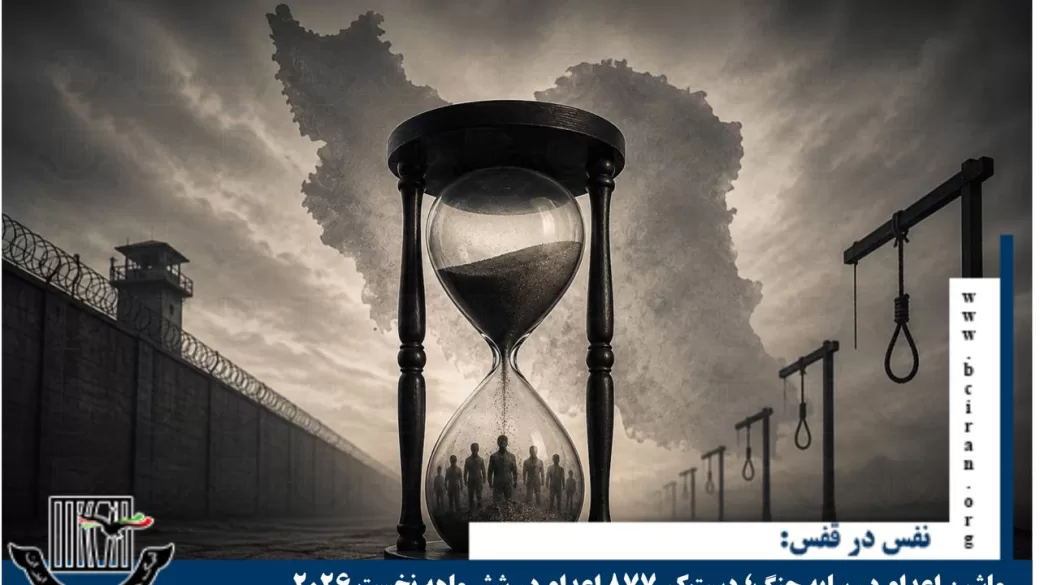
Execution in the Shadow of War: At Least 877 Executions in the First Half of 2026
3 July 2026
News Category: Executions
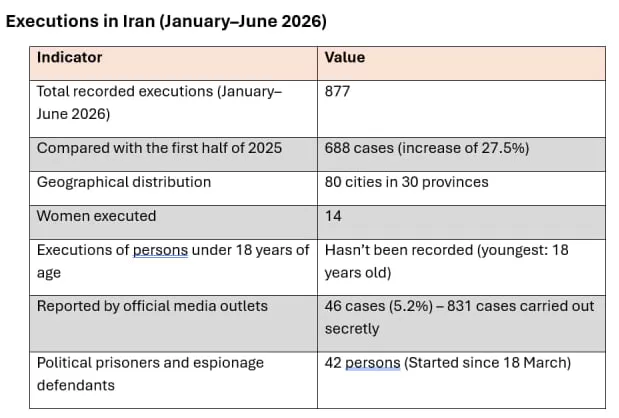
Breathing in Confinement — The Statistics Centre of the Prisoners’ Rights League in Iran has released its statistical report on executions during the first six months of 2026, based on daily monitoring and case-by-case documentation. The figures paint a deeply alarming picture: at least 877 people were executed in Iran between 1 January and 23 June 2026 — an average of nearly five executions per day and a 27.5 percent increase compared with the same period last year.
With more than 2,200 executions recorded, 2025 was the deadliest year in recent decades. Yet the first half of 2026 indicates that the Islamic Republic has not retreated from this path but has instead accelerated it.
January 2026, with 352 executions, was the deadliest month ever documented by this centre, representing a 3.6-fold increase compared with January of the previous year. These executions occurred before the outbreak of war, indicating that the recent surge in executions was a premeditated policy rather than a temporary response to the conflict.
Following the onset of war, a curtain of silence descended over the prison system. During March and April, independent reporting became virtually impossible, and only official information reached the outside world. The figures recorded for these two months should therefore be regarded as a minimum estimate rather than a reflection of reality, suggesting that the actual number of victims in the first six months of this year exceeds 877.
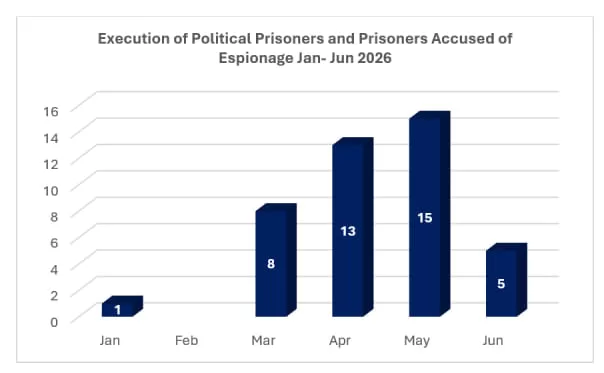
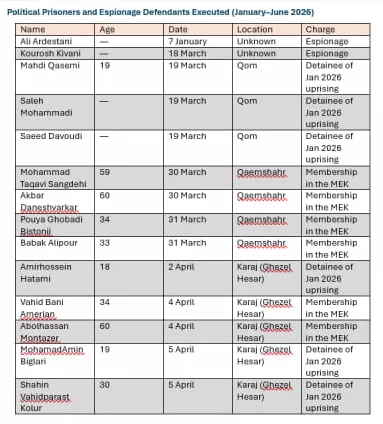
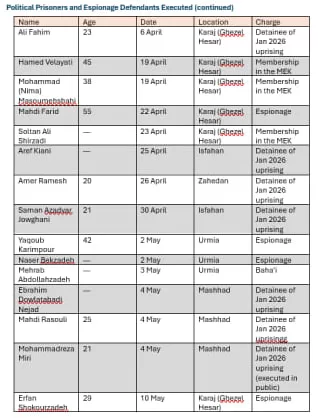
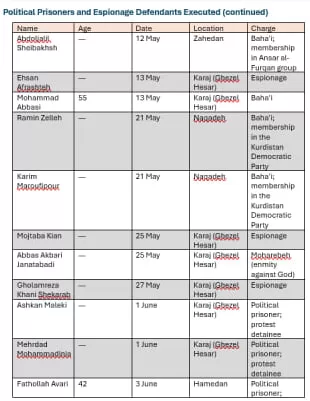
The most troubling pattern during this period has been the government’s clear shift toward political executions amid wartime conditions. Since 18 March, 41 political prisoners and individuals accused of espionage have been executed, whereas the total number of such executions throughout 2025 reached 25 cases.
Prisoners accused of affiliation with opposition organisations, as well as detainees arrested during nationwide protests, have been sent to the gallows under vague charges such as baghi (“armed rebellion against the Islamic state”) and espionage, while the country was engulfed in war and public attention was constrained by a climate of limited information.
A particularly disturbing aspect of this policy is that the authorities reportedly carry out approximately 95 percent of executions in secrecy, yet publicly announce political executions through the official judiciary news agency. In other words, these executions appear to function as instruments of intimidation and tools of state repression.
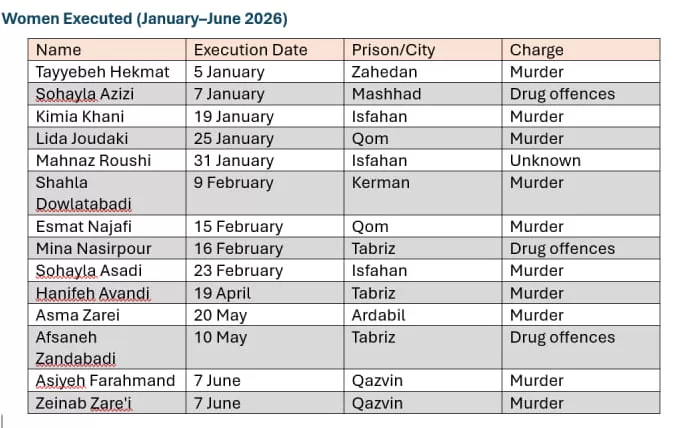
During the same six-month period, 14 women were executed. In many of these cases, consistent with a recognised pattern in homicide cases involving women, the circumstances stemmed from forced marriages, domestic violence, and a lack of legal protection.
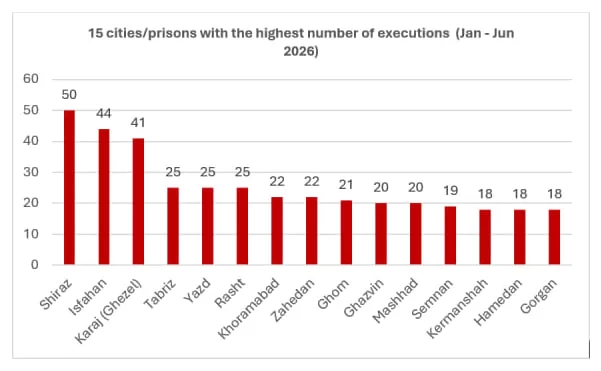
The geographical scope of executions spans 80 cities and prisons across 30 provinces, from Adelabad Prison in Shiraz to Qezel Hesar Prison in Karaj, illustrating a nationwide policy that affects virtually every part of the country.
The backbone of Iran’s execution apparatus remains convictions related to murder and drug offences. Such cases frequently proceed through proceedings lasting only a few minutes, without fair trial guarantees and often relying on coerced confessions, ultimately resulting in death sentences.
The Prisoners’ Rights League in Iran once again emphasises that executions in Iran serve not as an instrument of justice but as a pillar of governance through intimidation.
The organisation calls upon international bodies — including the United Nations Human Rights Council, the Special Rapporteur on the situation of human rights in Iran, and member states — to treat the wave of wartime executions as a distinct and urgent matter, to demand an immediate halt to executions, particularly those involving political prisoners and protesters, and to activate international accountability and documentation mechanisms for officials responsible for ordering and carrying out these executions.
The organisation also urges the media and the international public not to allow the information blackout imposed by war to become a graveyard of silence for prisoners.
The full statistical report, including monthly trends, categories of charges, geographical distribution, statistics on women executed, hidden executions, and the names of political prisoners executed during this period, is presented in the remainder of the report.
All figures presented are minimum estimates, and responsibility for each of these 877 deaths rests directly with the Islamic Republic of Iran.
Executions in Iran (January–June 2026)
Part I – Special Report: June 2026
During the first 23 days of June 2026, at least 106 people were executed in Iran, equivalent to an average of more than four executions per day.
This figure represents an increase of approximately 18 percent compared with May (90 executions) and confirms a renewed upward trend in executions following the decline recorded during March and April.
Since the data included in this report cover only the period up to 23 June, the final number of executions for the entire month is likely to be significantly higher.
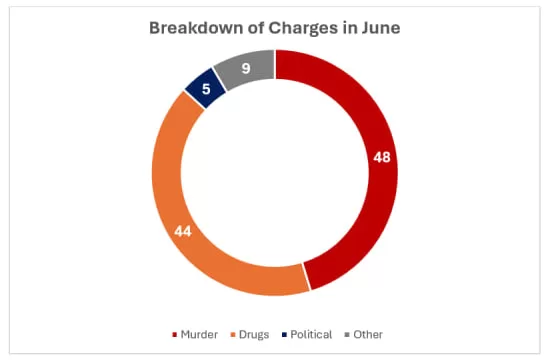
Breakdown of Charges in June
Executions for murder (48 cases) and drug-related offenses (44 cases) together accounted for 87 percent of all executions recorded in June.
In addition:
5 political prisoners were executed.
9 individuals were executed on other charges, including rape and moharebeh (enmity against God) through armed robbery.
Geographic Distribution in June
Executions recorded in June were carried out in 38 cities and prisons across 25 provinces, illustrating the nationwide reach of the execution machinery.
The highest numbers were documented in: Shiraz (10), Yazd (9), Isfahan (9), Zahedan (8), Hamedan (7), Ghezel Hesar Prison, Karaj (6).
Geographic Distribution in June
Executions recorded in June were carried out in 38 cities and prisons across 25 provinces, illustrating the nationwide reach of the execution machinery.
The highest numbers were documented in: Shiraz (10), Yazd (9), Isfahan (9), Zahedan (8), Hamedan (7), Ghezel Hesar Prison, Karaj (6).
Women Executed in June
On 7 June, two women — Asieh Farahmand and Zeinab Zari —were executed simultaneously in Qazvin Prison on murder charges.
Political Prisoners Executed in June
Five political prisoners executed in June had been arrested during protest movements, and their executions were officially announced through the Judiciary’s Mizan News Agency:
Ashkan Maleki and Mehrdad Mohammadinia (1 June – Ghezel Hesar Prison)
Fathollah Avvari (3 June – Hamedan)
Javad Zamani (16 June – Shahroud)
Abolfazl Saeedi (17 June – Shahroud)
Of the 106 executions recorded in June, only six cases were publicly announced by state media, while the remaining 100 executions were documented solely through human rights sources.
Part II – Overall Picture: January to June 2026
From 1 January to 23 June 2026, at least 877 people were executed in Iran, compared with 688 executions during the same period in 2025, representing an increase of more than 27 percent.
January 2026, with 352 executions, was the deadliest month ever documented, recording a figure 3.6 times higher than January 2025.
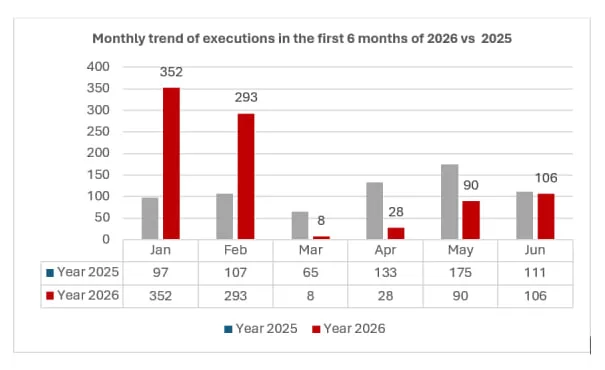
The dramatic decline in recorded executions during March and April 2026 (8 and 28 cases respectively) coincided with wartime conditions, communication disruptions, and the near impossibility of independent monitoring.
In March, every documented execution was based solely on official announcements, and no independent reporting could be verified.
Consequently, the figures for these two months should be understood as the minimum documented number of executions rather than the actual total.
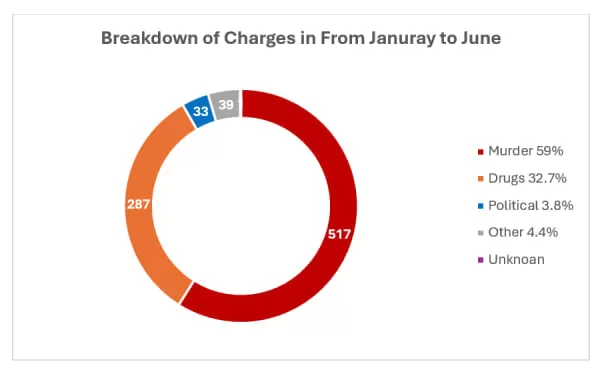
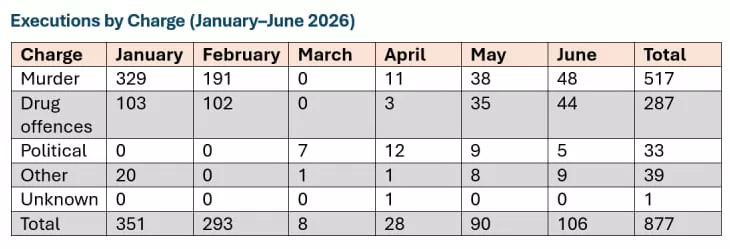
Executions for murder (517 cases; 59%) and drug-related offenses (287 cases; 33%) constitute the overwhelming majority of executions recorded during the first half of 2026.
Political executions (33 cases) and executions carried out on espionage-related charges (9 cases included within the category of “Other”) have increased sharply and without precedent since 18 March 2026.
Part III – Geographic Distribution of Executions
Executions during the first six months of 2026 were carried out in at least 80 cities and prisons across 30 of Iran’s 31 provinces.
The absence of Tehran Province from the statistics largely reflects the transfer of executions previously carried out in the capital to Ghezel Hesar Prison in Karaj (Alborz Province).
This geographic distribution demonstrates that executions in Iran are not an isolated or localized phenomenon, but rather constitute a nationwide policy.
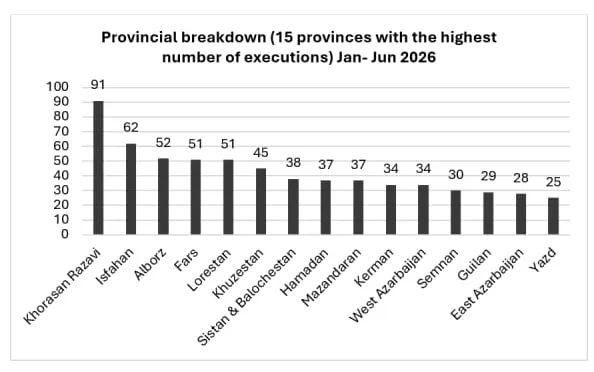
Provinces with the Highest Numbers
Razavi Khorasan: 91 executions, Isfahan: 62 executions, Alborz: 52 executions, Fars: 51 executions, Lorestan: 51 executions.
Part IV – Executed Women
At least 14 women were executed during the first half of 2026.
For comparison:
First half of 2025: 23 women
Entire year 2025: 63 women
Most women executed during this period were convicted on murder charges.
The report notes that many cases involving women sentenced to death are closely linked to: Domestic violence, forced marriage and lack of effective legal protection.
Part V – Executions of Children and Juveniles
No executions of persons under the age of 18 were documented in the data collected for the first half of 2026.
The youngest person executed whose age was recorded was Hossein Hatami, aged 18, who was executed on 2 April in Ghezel Hesar Prison, Karaj, among those classified as political prisoners.
It should be noted, however, that age information was available for only 189 out of 877 executed individuals, and the age at the time the alleged offence was committed—which constitutes the relevant criterion under international law for determining whether an individual is a child offender—was not documented.
Accordingly, it is not possible to conclude definitively that no child offenders were executed during this period.
For comparison, at least seven child offenders were executed in Iran during 2025.
Part VI – Hidden Executions and Official Announcements
Of the 877 executions documented during the first six months of 2026, only 46 cases (5.2%) were officially announced by state media, primarily through the Judiciary’s news agency, Mizan.
The remaining 831 executions (94.8%) were documented solely through human rights organizations and activists without any official acknowledgment.
The pattern of official announcements is significant: the authorities tend to publicize executions involving political, security-related, or espionage charges—cases that may serve an intimidating function—while ordinary executions are largely carried out in silence.
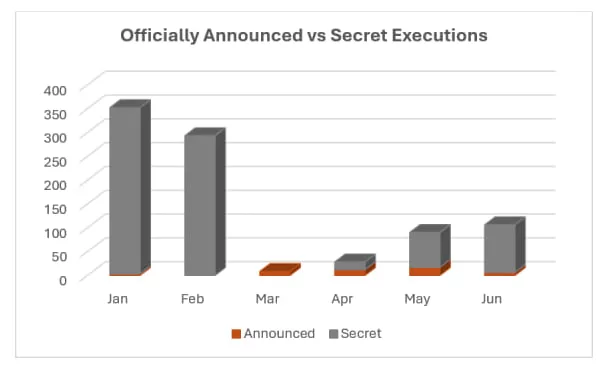
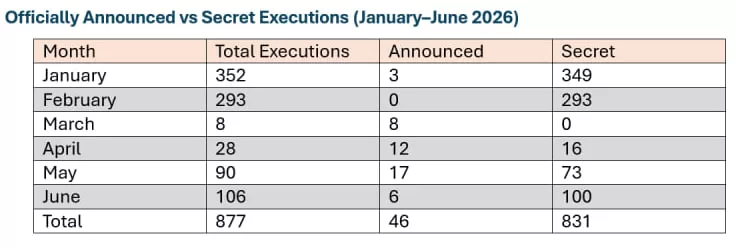
For comparison, out of 2,204 executions documented in 2025, only 87 cases (4%) were officially announced
Part VII – Executions of Political Prisoners Amid Wartime Conditions
The most striking development during the first half of 2026 has been the unprecedented wave of executions of political prisoners and individuals accused of espionage.
A total of 42 political prisoners and persons accused of espionage were executed between January and June 2026, 41 of whom were executed after 18 March 2026.
Almost all of these executions were accompanied by official announcements through Mizan News Agency, suggesting that the authorities have employed such executions as instruments of domestic intimidation during wartime.
By comparison, the total number of political, security-related, and espionage executions recorded throughout 2025 was 25 cases.
Categories of Charges
Among the 42 executed individuals:
9 persons were accused of membership in the People’s Mojahedin Organization of Iran (PMOI/MEK).
9 persons were accused of espionage.
5 persons in connection with nationwide protests.
6 persons were convicted of baghi (armed rebellion) or moharebeh (enmity against God), including three individuals publicly executed in Mashhad.
2 persons were accused of membership in the Democratic Party of Iranian Kurdistan (PDKI).
1 person was accused of membership in Ansar al-Furqan.
10 individuals were executed under charges that were not publicly disclosed.
Part VIII – Comparison with 2025 and Outlook
With at least 2,204 executions, 2025 was the deadliest year in recent decades.
However, the first half of 2026, with 877 executions, is already 27.5 percent ahead of the corresponding period in 2025.
Experience from 2025 demonstrated that the pace of executions accelerated significantly during the second half of the year, increasing from 117 executions in July to 321 executions in November. Should a similar pattern recur, 2026 may surpass the record set in 2025.
Three characteristics distinguish the first half of 2026:
First, the historic record of 352 executions in January, making it the deadliest month ever documented.
Second, the organized wave of executions of political prisoners beginning on 18 March, carried out amid wartime conditions and accompanied by official publicity.
Third, the continuation of systematic secrecy, with approximately 95 percent of executions taking place without official announcement.
Methodology and Notes
This report is based on case-by-case documentation comprising 877 individual records collected between 1 January and 23 June 2026.
Sources include: reports from human rights activists and networks operating inside Iran;
independent monitoring and documentation efforts; and official announcements, primarily disseminated through Mizan News Agency, the news outlet affiliated with the Iranian Judiciary.
The identities of 43 executed individuals remain unknown.
Age information was available in only 189 cases, and the exact date of execution for a number of cases recorded in February could not be established.
The figures reported for March and April should be regarded as underestimates of the actual number of executions, owing to wartime conditions, communication disruptions, and severe constraints on independent reporting.
All statistics presented in this report should therefore be considered minimum estimates.