
Political prisoner Mohammad Sharqi, detained during January protests, sentenced to death
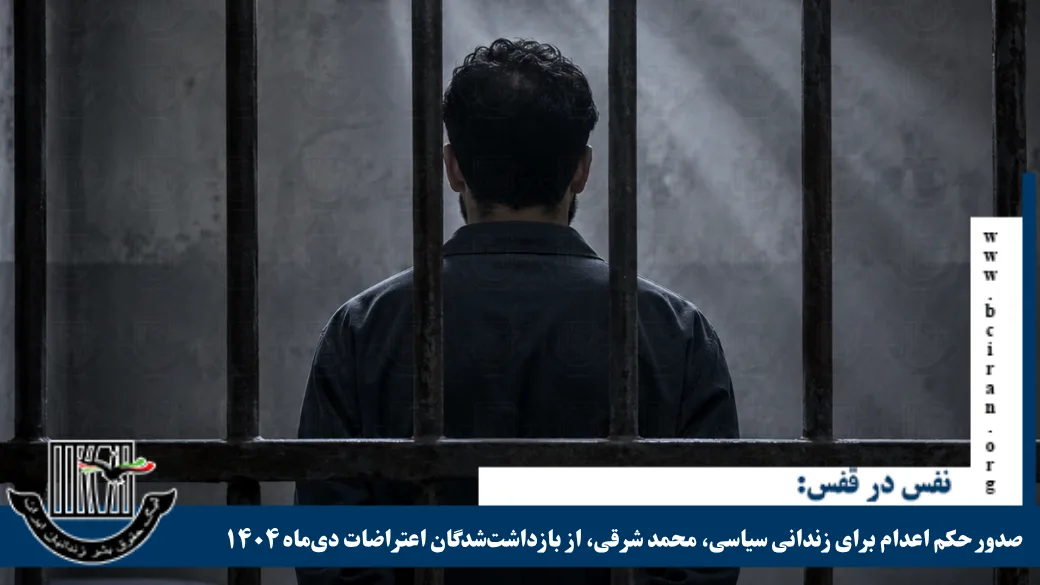
Breathing in Confinement, Thursday, November 26, 2026 — Political prisoner Mohammad Sharqi, who was detained during the January protests and is being held in Qezel Hesar Prison, has been sentenced to death on charges of “membership in anti-government groups.”
According to Breathing in Confinement, the news outlet of Prisoners’ Rights in Iran, Mohammad Sharqi, an employee of the security department at Tehran’s Mehrabad Airport, was sentenced to death by Branch 23 of the Tehran Revolutionary Court. After he challenged the verdict, his case was referred to Branch 9 of the Supreme Court for review. The outcome has not yet been announced.
Sharqi was sentenced to death on security-related charges, including “operational action on behalf of hostile states” and “membership in anti-government groups.” The details and evidence relied upon by the court to attribute these charges to him have not been made public transparently.
According to information received, Mohammad Sharqi was arrested by security forces on March 17, 2026, in connection with the January protests that year. At the time of his arrest, he was working in the security department at Tehran’s Mehrabad Airport. He was transferred to prison after his arrest and is currently being held in Qezel Hesar Prison in Karaj.
Informed sources say that Sharqi challenged the sentence and that his case was referred to Branch 9 of the Supreme Court for review. However, no information has been released about the date of his trial, the details of his defence, the evidence used to substantiate the charges, or whether he had access to a lawyer of his own choosing who was independent.
The sentencing to death of people detained during protests—particularly in cases involving serious security charges—raises grave concerns about compliance with fair-trial standards and the possible use of the death penalty as a means of repression and intimidation in society.
Under international human rights standards, including Articles 6 and 14 of the International Covenant on Civil and Political Rights, the right to life and the right to a fair trial are fundamental rights. In cases that may result in the death penalty, safeguards must be upheld with particular care, including access to an independent lawyer, the ability to mount an effective defence, impartial consideration of the evidence, and the right to appeal. Any serious violation of these safeguards may call the legitimacy of the sentence into question and carry the irreversible risk of depriving a person of their right to life.
Leave a Reply