Monthly Report on Human Rights Violations in Iran – 20 June to 20 July 2026: At Least 55 Prisoners Executed
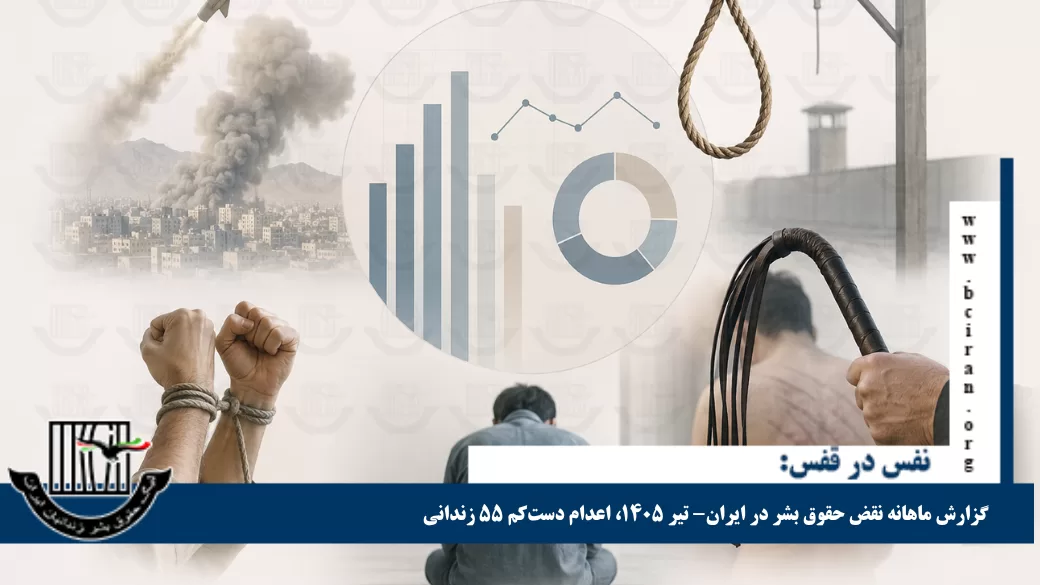
Breathing in Confinement: The Statistics Centre of the Prisoners’ Rights League in Iran has published its monthly report on human rights violations in Iran covering the past Iranian month (20 June- 20 July).
The past month unfolded amid escalating military tensions between the Islamic Republic of Iran and the United States, which provided a pretext for intensified domestic repression. Available reports and evidence point to an alarming deterioration in the human rights situation during this period, marked by an increase in the issuance and implementation of death sentences, arbitrary arrests, and restrictions on fundamental freedoms. Taking advantage of the heightened security environment and wartime crisis, the authorities intensified their crackdown on opponents and increased pressure on prisoners.
During the reporting period, at least 55 executions were recorded, including those of five political prisoners, demonstrating the continued use of the death penalty as a means of instilling fear and exerting control over society. At the same time, the “Tuesdays Against Execution” campaign continued into its 130th week across 59 prisons nationwide. In addition, approximately 1,500 death-row prisoners in Unit 2 of Qezel Hesar Prison launched a hunger strike in protest against the resumption of executions and the transfer of prisoners for execution. They called for the abolition of all death sentences, including those imposed on political prisoners.
On 15 July alone, at least 19 prisoners—equivalent to approximately 35 per cent of all executions recorded during the month—were executed, primarily in Unit 2 of Qezel Hesar Prison.
The United Nations Fact-Finding Mission on Iran expressed concern over death sentences imposed on political defendants in the case known as the “Meydan Alikhani” case in Isfahan and called for the executions to be halted.
The Statistics Centre of the Prisoners’ Rights League in Iran publishes its latest assessment of the human rights situation based on reports documented and registered by the Centre. Through documentation and statistical analysis of these developments, the report seeks to provide a clear picture of the human rights situation in Iran during the past month.
Summary:
• At least 55 prisoners were executed, including five political prisoners.
• Death sentences were issued against at least 28 defendants, including 19 political prisoners, while the death sentences of five other defendants were upheld by the Supreme Court.
• At least 96 citizens were arrested on political, religious, media-related, and civil-society grounds.
• Flogging sentences were issued against at least 16 defendants. Among the documented cases, at least seven individuals, including five political prisoners, were sentenced to a combined total of 537 lashes.
• Prison sentences totalling 459 years, nine months and one day were imposed on 88 political and religious defendants.
• Three prisoners died in custody.
• At least 18 workers were killed in workplace accidents, while at least 67 others were injured.
• At least 240 workers were dismissed from several industrial and service-sector workplaces, amid an annual inflation rate of 66 per cent as reported by the Statistical Center of Iran.
• At least 10 women were victims of domestic violence and killings.
• More than 400 protest actions took place, while the “Tuesdays Against Execution” hunger-strike campaign continued into its 130th week across 59 prisons nationwide.
Section One: Overall Execution Statistics
1.1 Five-Year Trend During the Month of July
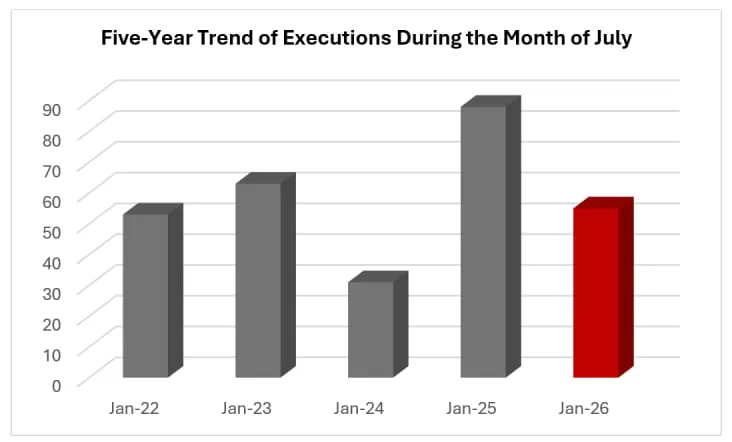
A comparison of execution figures for the month of July over the past five years shows considerable fluctuation, but also the uninterrupted use of the death penalty: 53 executions were recorded in July 2022, 64 in July 2023, followed by a significant decline to 31 in July 2024. The figure then rose sharply to 88 in July 2025—the highest recorded during this five-year period—before falling to 55 in July this year.
Although this year’s figure represents a decrease of approximately 37 per cent compared with last year, it remains close to the five-year average of 58 executions and is substantially higher than the figure recorded in July 2024. This trend indicates that the decline from last year’s record high should not be interpreted as evidence of a structural change in the authorities’ approach to the use of the death penalty.
1.2 Reported Charges
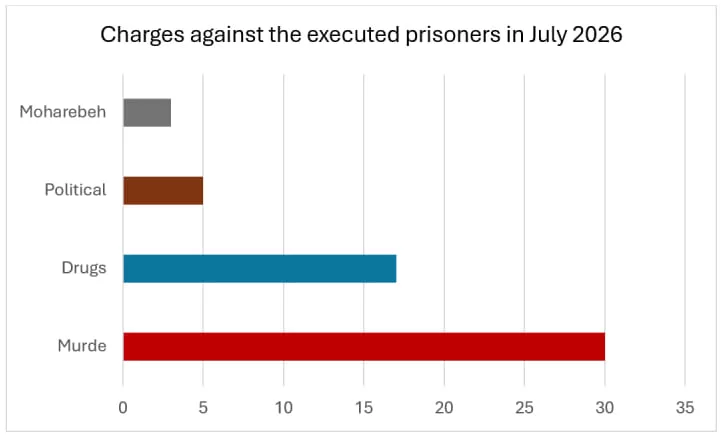
According to the Statistics Centre of the Prisoners’ Rights League in Iran, among the 55 executions recorded in the past month, the most frequently reported charge was “murder,” accounting for 30 cases (55 per cent), followed by drug-related offences with 17 cases (31 per cent).
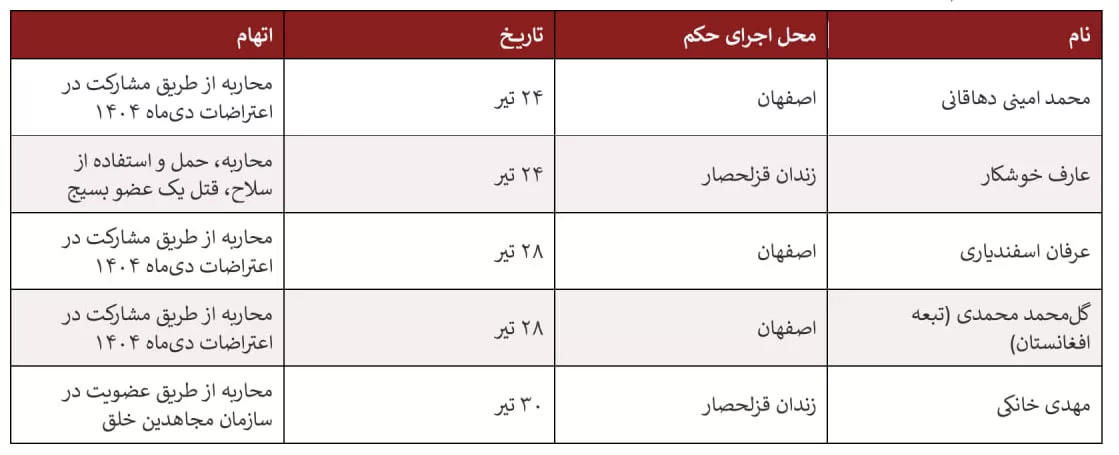
Five political prisoners (9 per cent)—Mohammad Amin Dehghani, Aref Khoshkar, Erfan Esfandiari, Gol Mohammad Mohammadi, and Mehdi Khanaki—were executed. The first four had been sentenced to death on the charge of “moharebeh” (enmity against God) in connection with participation in the nationwide protests of January this year, while Mehdi Khanaki had been sentenced to death on the charge of “moharebeh through membership in the People’s Mojahedin Organization of Iran.”
In the remaining cases, the reported charges included two cases of “baghi” (armed rebellion) through membership in ISIS, and one case of “moharebeh” in connection with armed robbery.
1.3 Transparency Gap: Officially Announced vs Secret Executions
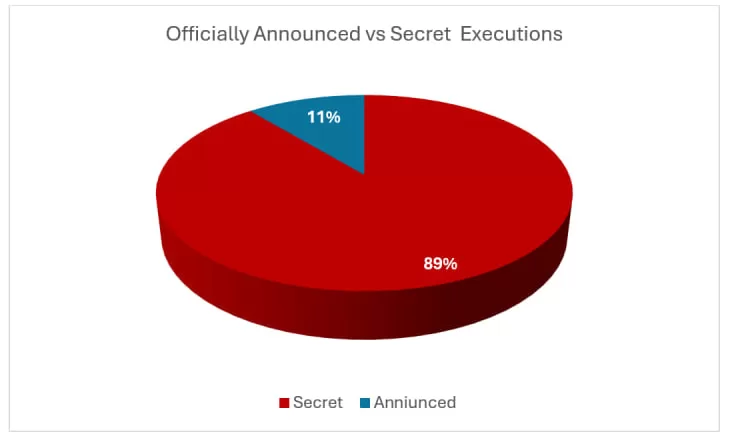
Of the 55 executions documented during the past month, only six cases (11 per cent) were officially announced by government sources. The remaining 49 executions (89 per cent) were documented and published exclusively by human rights organisations and independent sources.
This substantial gap between official figures and independent documentation once again highlights the systematic lack of transparency surrounding executions in Iran. It also demonstrates that the vast majority of executions are carried out without official media coverage and, in many cases, without prior notification to prisoners’ families or lawyers.
1.4 Distribution of Executions Throughout the Month
The distribution of executions throughout the month was highly uneven. On 15 July alone, at least 19 prisoners—equivalent to 35 per cent of all executions recorded during the month—were executed, primarily in Unit 2 of Qezel Hesar Prison.
These mass executions took place while approximately 1,500 death-row prisoners in the same prison were on hunger strike in protest against the resumption of executions. This can be viewed as an example of a pattern of “execution waves,” in which multiple executions are carried out within short, concentrated periods in an apparent effort to maximise their intimidating effect.
Another cluster of executions was recorded between 12 and 14 July, when 12 executions took place, while a further five executions were recorded on 22 July.
1.5 Geographical Distribution
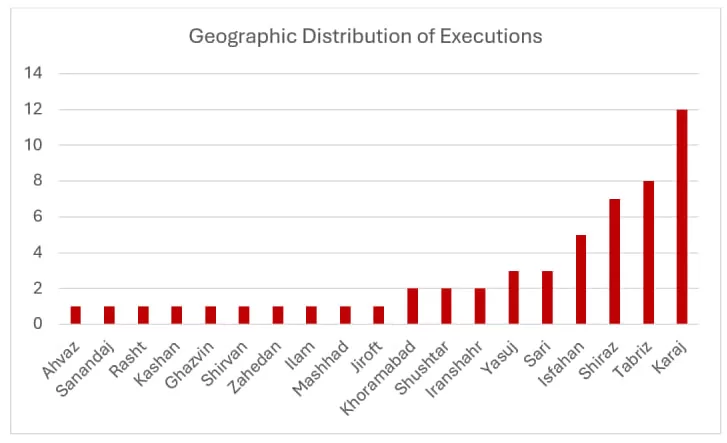
Executions in the past month were carried out in at least 19 cities across more than 15 provinces, ranging from Sistan and Baluchestan to East Azerbaijan and from Khuzestan to Razavi Khorasan, demonstrating the nationwide extent of the practice.
The geographical distribution, however, was far from uniform. Qezel Hesar Prison in Karaj accounted for 12 executions (22 per cent), followed by Tabriz with eight (15 per cent) and Shiraz with seven (13 per cent). In other words, half of all executions carried out nationwide were concentrated in just three locations.
The concentration of executions at Qezel Hesar is particularly significant given the simultaneous large-scale hunger strike by death-row prisoners at the same prison, further highlighting Qezel Hesar’s role as one of the principal centres for carrying out death sentences in Iran.
Section Two: Analysis Based on the Characteristics of The Executed Prisoners
2.1 Gender
At least two women were executed in the past month: Setayesh Mohammadpour, who was executed in Shiraz Prison on a drug-related charge, and Parvin Chardovali, whose death sentence was carried out in Qezel Hesar Prison on a charge of “murder.”
The trend in the previous 4 months indicates that the number of women executed has remained relatively stable—between one and two per month—but persistent. In contrast, the number of men executed has fluctuated considerably, reaching a peak of 141 in June.
According to the Statistics Centre of the Prisoners’ Rights League in Iran, at least 67 women were executed in prisons across the country in the last Persian year (from March 20, 2025, to March 20, 2026). Among them was one juvenile offender. This further highlights the gender-related and intergenerational dimensions of structural violence against women within Iran’s criminal justice system.
2.2 Juvenile Offenders: Execution of Individuals Who Were Under the Legal Age at the Time of the Offence
Meysam Irandegani, who was only 14 years old at the time of the alleged offence, was executed in Iranshahr Prison after reaching the age of 18.
Executing an individual who was a child at the time of the offence, regardless of their age at the time the sentence is carried out, is in clear violation of the Convention on the Rights of the Child (CRC), which categorically prohibits the execution of individuals who were under the age of 18 when the offence was committed.
Delaying an execution for several years until a convicted juvenile reaches the legal age—a practice employed within Iran’s criminal justice system—does not alter the fact that the punishment violates the rights of the child and has been subject to serious criticism under international human rights law.
2.3 Political and Security Prisoners
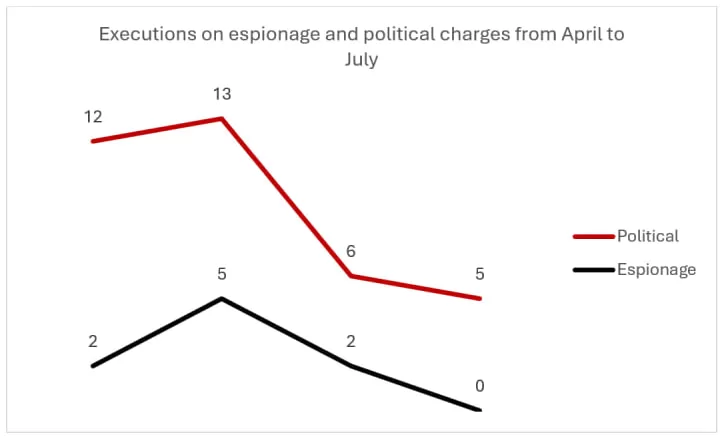
The execution of political prisoners showed a declining but persistent trend from the last 4 months: 12 political prisoners were executed in April, 13 in May, six in June, and five in July.
During the same period, executions on espionage charges increased from two cases in April to five in May, before declining to two in June and none in July.
Nevertheless, the lower monthly number of political prisoners executed should not be interpreted as evidence of reduced pressure on this group. During the same month, the Supreme Court upheld the death sentences of 12 political prisoners in the case known as the “Alikhani Square” case in Isfahan, raising the possibility that these sentences could be carried out in the coming months.
2.4 Foreign Nationals
Among those executed in the past month, Gol Mohammad Mohammadi was identified as an Afghan national. The presence of foreign nationals and Afghan migrants among those executed in Iran has been repeatedly documented in execution statistics in recent years and represents another concerning dimension of the country’s extensive use of the death penalty.
Section Three: The Islamic Republic of Iran and Systematic Violations of International Standards
While a large part of the international community is moving towards restricting and abolishing the death penalty, the Islamic Republic of Iran continues to have the second-highest execution rate in the world and systematically disregards fundamental human rights principles.
Despite being a party to some of the most important international human rights treaties, Iran has, in practice, failed to demonstrate meaningful compliance with its obligations:
• International Covenant on Civil and Political Rights (ICCPR) — which affirms the right to life, prohibits torture, and guarantees the right to a fair trial.
• Convention on the Rights of the Child (CRC) — which explicitly prohibits the execution of individuals who were under the age of 18 at the time the offence was committed.
• Convention on the Elimination of All Forms of Discrimination against Women (CEDAW) — Iran is not a party to this Convention; however, its laws and practices concerning women sentenced to death exacerbate structural discrimination and violence against women.
• United Nations safeguards concerning the use of the death penalty — which require capital punishment to be restricted to the “most serious crimes” and imposed only following proceedings that fully comply with fair-trial guarantees; standards that are rarely observed in Iran.
Section Four: Issuance and Confirmation of Death Sentences
During the past month, death sentences were issued against at least 28 defendants, while the death sentences of five other prisoners were upheld by the Supreme Court. Of those sentenced to death, 19 were political prisoners, and nine had been convicted of “murder.”
Political prisoners Arghavan Fallah and Amirhossein Moradi-Monfared were sentenced to death by Branch 15 of the Tehran Revolutionary Court, presided over by Judge Abolghasem Salavati, on the charge of “baghi” (armed rebellion) through alleged links with the People’s Mojahedin Organization of Iran.
Vahid Khansanimi was sentenced to death by the same branch on the charge of “moharebeh” (enmity against God) through participation in the January protests. Kamal Khanbabai was sentenced to death on charges of “moharebeh” and destruction of public property during the same protests by Branch 1 of the Qazvin Revolutionary Court, presided over by Judge Asadi. Mahnam Navab-Safavi was also sentenced to death on a similar charge.
Mojtaba Dehbandi and Kianoush Hamzeh-Kazerouni were sentenced to death by the Shiraz Revolutionary Court on the charge of “providing medical assistance to people injured during the nationwide protests of January this year.”
In another significant development, the Supreme Court upheld the death sentences of 12 political prisoners in the case known as the “Alikhani Square” case in Isfahan. The sentences had been issued in connection with the January protests:
• Alireza Sepahi
• Abolfazl Sepahi
• Ghaem Hosseini
• Gol Mohammad Mohammadi
• Shervin Bagherian
• Erfan Esfandiari
• Amirhossein Safari
• Amirhossein Maleki
• Ali Dashti
• Abolfazl Ebrahimi
• Alireza Raeisi
• Amirhossein Ebrahimi Analucheh
It should be noted that a number of other political prisoners in different cities across Iran have reportedly either been sentenced to death or had their death sentences upheld by the Supreme Court. However, because of delays in the disclosure of information concerning these cases, they have not been included in this report. This suggests that the actual figures are likely higher than those documented here.
Section Five: Wave of Arrests
During the past month, amid heightened regional tensions and the continuing pattern of domestic repression, the wave of arrests of citizens across Iran continued.
According to documented figures, at least 96 citizens were arrested during the month on various grounds, including political charges, alleged links or cooperation with groups opposed to the government, contact with media outlets based outside Iran, advocacy and campaigning activities, activities related to religious minorities, and the expression of views on social media.
These arrests took place alongside an increase in executions and the expansion of security pressure on civil society and political and religious activists.
Those arrested included a broad range of individuals:
• Former political prisoners
• Relatives of political prisoners and families seeking justice
• Political and civil society activists, journalists and media workers, artists, and social media activists
• University students, teachers, and lawyers
• Baha’i citizens and members of other sections of society
Security-related measures against citizens, civil society activists, journalists, and political and religious activists continue to serve as one of the authorities’ principal means of restricting freedom of expression and suppressing protest and demands for social change.
Section Six: Judicial Sentences, Imprisonment, Flogging, and Deaths in Custody
6.1 Prison Sentences
Judicial sentences were issued in cases involving 88 political and religious defendants. The total prison sentences imposed amounted to 263 years, 10 months, and 18 days.
In addition, the sentences imposed on 32 prisoners in the “Alikhani Square” case, related to the January protests—each of whom was sentenced to between five and 10 years in prison—bring the overall total to a higher figure, although the precise breakdown of these sentences has not been made clear.
Four political prisoners were arrested to begin serving their prison sentences.
6.2 Deaths in Prison
According to reports received during the past month, three prisoners died in prisons.
Mostafa Nezami, 33, who had been sentenced to death on a charge of “murder,” and Shahab Bavi, a death-row prisoner convicted in a drug-related case, both died in Qezel Hesar Prison in Karaj. Their deaths were reported as suicides.
Afshin Albandi, a boxing champion and member of the national team, also died in Isfahan Prison. Poor prison conditions and an illness from which he was suffering were cited as contributing factors in his death.
The deaths of these three prisoners have once again raised concerns over inappropriate detention conditions, insufficient access to medical care, and the psychological pressures faced by prisoners in Iran.
6.3 Issuance and Implementation of Flogging Sentences
During the past month, at least seven defendants, including five political prisoners, were sentenced to a combined total of 537 lashes.
Six political prisoners arrested in connection with the January protests were sentenced to flogging: Nima Shiri (74 lashes), Hamzeh Ahmadi-Taraghi (148 lashes), Yashar Reyhani (80 lashes), Neda Dehjani (31 lashes), and Setayesh (Behnoush) Shahi (31 lashes). In addition, a female prisoner named Anita was sentenced to 74 lashes on the charge of “offending public decency,” while another prisoner was sentenced to 99 lashes on a charge of “rape.”
Flogging constitutes a form of corporal and degrading punishment that is incompatible with the principle of human dignity and with international human rights standards, including the provisions of the International Covenant on Civil and Political Rights prohibiting inhuman treatment. Nevertheless, such sentences continue to be issued and carried out within Iran’s judicial system.
Section Seven: Workers — Workplace Accidents, Mass Dismissals, and the Economic Crisis
7.1 Workplace Accidents
Due to inadequate workplace safety, at least 18 workers lost their lives in occupational accidents during the past month, while a further 67 workers were injured.
The main factors contributing to these incidents included the absence of standard safety equipment, inadequate training and supervision, and negligence by employers.
According to Iran’s Deputy Minister of Health, approximately 10,000 people die each year as a result of workplace accidents in Iran, while officially recorded statistics account for slightly more than 2,000 deaths annually.
This statistical discrepancy itself illustrates the hidden scale of Iran’s occupational safety crisis.
It is Important to note that informal workers, kolbars (cross-border porters), and fuel carriers are largely excluded from these official figures.
7.2 Dismissal of Workers
During the past month, at least 240 workers were dismissed from several industrial and service-sector workplaces across the country.
Several employees of the “Seyr-o-Harekat” railway company in Zahedan were dismissed for unspecified reasons. Fifty-eight workers employed by Iran Marine Industrial Company (SADRA) were dismissed without any stated justification.
A further 150 workers at Petrovanad Petrochemical Company lost their jobs as part of what was described as “workforce downsizing,” while 32 employees of Iranshahr Municipality were reportedly dismissed following pressure from the municipality’s security department and the Ministry of Intelligence.
7.3 Analysis: The Link Between Worker Dismissals and Official Economic and Inflation Data
According to reports published by official Iranian institutions, the dismissals recorded during the past month occurred against a backdrop of steadily deteriorating living conditions for workers.
The Statistical Center of Iran reported an annual inflation rate of 66.0 per cent for the month of July. This means that the Consumer Price Index over the 12 months ending in July increased by 66 per cent compared with the corresponding period of the previous year.
The point-to-point inflation rate—the direct comparison between July this year and July last year —was even higher, at 87.9 per cent. In other words, the cost of a fixed basket of goods and services for an Iranian household had almost doubled within a single year. Monthly inflation in July was recorded at 3.1 per cent, indicating that the erosion of purchasing power continued at a rapid pace.
According to the same official report, lower-income households faced considerably greater pressure than wealthier groups. The second income decile experienced an inflation rate of 73.5 per cent, compared with 63.9 per cent for the tenth decile. This disparity has a direct impact on the working population, which is predominantly concentrated within the lower-income groups.
At the same time, the official unemployment rate among people aged 15 and over rose to 9.1 per cent in the past 4 months, an increase of 1.8 percentage points compared with the same period the previous year. Unemployment among young people aged 15 to 24 climbed to 23.4 per cent, meaning that nearly one in four economically active young people in the country was unemployed.
Against this background, the dismissal of at least 240 workers during the past month, although relatively limited in absolute numbers, is indicative of a broader structural trend involving workforce reductions, employment instability, and downsizing across industrial and service-sector workplaces—a trend reflected in the government’s own official statistics.
The reported dismissal of workers from Iranshahr Municipality following “pressure from the security department and the Ministry of Intelligence” also demonstrates that dismissal from employment may, in some cases, be used not merely for economic reasons but as a means of exerting security-related and disciplinary pressure.
Taken together, rising inflation, declining purchasing power, increasing unemployment, and widespread job losses without adequate employment protections or effective unemployment insurance have created a cycle of economic insecurity for Iran’s working population. This crisis is unfolding alongside, rather than independently of, political and civil repression.
Section Eight: Violence Against Women
During the past month, at least 10 women were killed as a result of acts of violence. Of these, eight were killed by members of their own families, with “family disputes” cited as the reported motive for the killings.
In one case, a woman was killed by her former fiancé, while another was killed by a suitor after she rejected his marriage proposal.
These figures once again highlight the alarming extent of violence against women and the continuing occurrence of killings linked to domestic violence, in the absence of an effective legal framework to protect women at risk.
Section Nine: Protests and Strikes
During the past month, more than 400 protest gatherings and actions took place across the country.
The “Tuesdays Against Execution” campaign reached its 130th week. As part of the campaign, political prisoners in 59 prisons across Iran—including Evin, Qezel Hesar, Mashhad, Urmia, Ahvaz, Tabriz, Sanandaj, Bukan, and Yasuj—went on hunger strike.
At the same time, Social Security pensioners, dismissed workers, workers from various sectors, employees, and individuals who had suffered financial losses also held protest gatherings over the authorities’ failure to address their demands.
Analysis and Final Conclusions
The Prisoners’ Rights League in Iran maintains that the events of this month should not be viewed as a series of isolated and unrelated incidents, but rather as interconnected elements of a broader pattern of repression.
Three key indicators from this month—the concentration of 35 per cent of all executions on a single day (15 July), the concentration of half of all executions in just three locations (Qezel Hesar, Tabriz, and Shiraz), and the fact that this wave of executions coincided with a hunger strike by 1,500 death-row prisoners at Qezel Hesar Prison—together reveal a clear pattern: mass executions carried out in rapid succession appear to serve as a punitive response to collective resistance by prisoners, rather than merely as the case-by-case implementation of judicial sentences.
This pattern also coincided with escalating regional military tensions. The assessment presented in this report is that, during periods of security and geopolitical crisis, the authorities lower the threshold for resorting to executions and large-scale arrests in an effort to increase, in advance, the potential cost of any domestic political protest.
The connection between seemingly different sections of this report is also significant. Annual inflation of 66 per cent and rising youth unemployment of 23.4 per cent—both confirmed by the government’s own Statistical Center—have coincided with arbitrary dismissals of workers. In at least one documented case, involving Iranshahr Municipality, dismissal from employment was reportedly directly linked to pressure from security and intelligence bodies. In other words, the distinction between political-security repression and the economic crisis became increasingly blurred during the past month, with the two functioning as different aspects of a broader system of social control.
The numerical decline in executions of political prisoners compared with previous months—from 12 in April to five in July—should therefore not be interpreted as an easing of pressure. During the same period, the Supreme Court upheld the death sentences of another 12 political prisoners in the “Alikhani Square” case, leaving them at risk of execution. In other words, the pipeline of political executions has not dried up; rather, further death sentences have been confirmed and remain pending.
Taken together, the events documented during the past month demonstrate the continuing widespread and systematic violation of human rights in Iran, with executions, the suppression of prisoners’ protests, and restrictions on fundamental freedoms being used as instruments of pressure and social control.
The statistical analysis presented in this report indicates that this repression is multidimensional and is being pursued simultaneously on several fronts: in the judicial sphere, through 55 executions, 28 newly issued death sentences, and the confirmation of a further 12 death sentences by the Supreme Court; in the security sphere, through the arrest of 96 citizens and the imposition of hundreds of years of imprisonment; through corporal punishment, with flogging sentences continuing to be imposed despite their incompatibility with international human rights standards; and in the economic and livelihood sphere, through 66 per cent inflation, rising unemployment, and widespread dismissals of workers, which, according to the government’s own official statistics, place a disproportionate burden on lower-income groups.
The geographical concentration of executions in a limited number of prisons, particularly Qezel Hesar, together with the mass execution of 19 prisoners on a single day, points to a pattern of concentrated waves of executions aimed at suppressing collective protest among death-row prisoners.
Against this backdrop, resistance and protest by prisoners—from the hunger strike involving 1,500 death-row prisoners at Qezel Hesar to the nationwide “Tuesdays Against Execution” campaign across 59 prisons—and growing public demands for the abolition of the death penalty underscore the urgent need to end this cycle of human rights violations and uphold the fundamental principles of the right to life and justice.
Recommendations and Proposed Actions for Government Authorities and International Bodies
The Prisoners’ Rights League in Iran, while warning of the human rights situation in Iran, calls on the authorities of the Islamic Republic to:
• Immediately declare a moratorium on the implementation of all death sentences, particularly in cases related to the January protests, including the “Alikhani Square” case in Isfahan, in which the Supreme Court has upheld the death sentences of 12 political prisoners.
• Permanently revoke death sentences imposed on individuals who were under the age of 18 at the time of the alleged offence, including in cases such as that of Meysam Irandegan, and review all similar cases in accordance with Iran’s obligations under the Convention on the Rights of the Child.
• End the issuance and implementation of flogging sentences and other forms of corporal and degrading punishment, and revoke existing flogging sentences imposed on political prisoners.
• Immediately and unconditionally release citizens detained solely for peaceful civil, media-related, student, or religious activities, and drop the charges against at least 96 citizens arrested during the past month.
• Guarantee death-row prisoners access to legal counsel of their choice and ensure that their families are officially notified in advance of any execution.
• Conduct independent, transparent, and verifiable investigations into the deaths of prisoners who have died in custody—including Mostafa Nezami, Shahab Bavi, and Afshin Albandi—and make the findings publicly available.
• Require public- and private-sector employers to comply with workplace safety standards and prohibit the arbitrary dismissal of workers without adherence to legal procedures, compensation, and effective unemployment protection.
To United Nations Human Rights Bodies and Mechanisms
• Extend and strengthen the resources and mandate of the Independent International Fact-Finding Mission on Iran and the Office of the United Nations Special Rapporteur on the situation of human rights in Iran.
• Urgently follow up on and publicly report the situation of the 12 political prisoners in the “Alikhani Square” case whose death sentences have been upheld by the Supreme Court and who are at risk of execution.
• Formally request independent access to and inspection of Qezel Hesar Prison, given the unusually high concentration of executions at the prison and the hunger strike involving at least 1,500 death-row prisoners held there.
• Formally refer cases involving the execution of individuals who were under the age of 18 at the time of the alleged offence to the United Nations Committee on the Rights of the Child for review and action.
To Governments and the International Community
• Impose or extend targeted sanctions against judicial officials responsible for issuing and implementing politically motivated death sentences, including officials and judicial branches identified in this report.
• Make diplomatic or economic engagement with the Islamic Republic of Iran conditional upon verifiable improvements in the human rights situation and a halt to executions.
• Provide financial, legal, and political support to independent Iranian human rights organisations documenting violations, which, in the absence of official transparency, documented 89 per cent of the executions recorded during the past month.
To International Labour and Economic Bodies
• The International Labour Organization (ILO) should monitor Iran’s compliance with fundamental labour standards, particularly regarding arbitrary dismissals, freedom of independent trade union organisation, and workplace safety.
• Call on the Iranian authorities to publish transparent, independent, and verifiable statistics on deaths resulting from workplace accidents, mass dismissals, and occupational injuries, including informal workers, kolbars, and fuel carriers, who are largely excluded from existing official statistics.