Flogging Sentences Carried Out Against Two Kurdish Women Activists; Continued Use of Corporal Punishment and Violation of Human Dignity
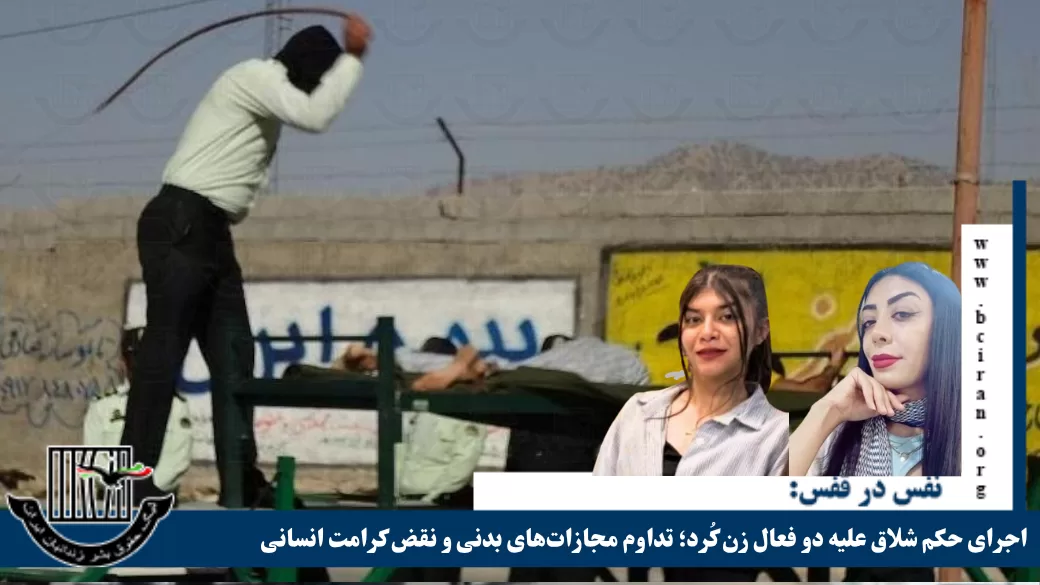
Breathing in Confinement, Tuesday, 25 August 2026: The sentences of 31 lashes imposed on Neda Dadejani and Setayesh (Behnoush) Sarabi, two Kurdish women activists from Qorveh who were arrested during the nationwide protests in January, have been carried out.
According to Breathing in Confinement, the news outlet of the Prisoners’ Rights League in Iran, the two women activists were arrested on Saturday, 22 August, after being summoned to the Qorveh court, where their flogging sentences were carried out. Following the implementation of the sentences, Neda Dadejani and Setayesh Sarabi were transferred to the women’s ward of Sanandaj Central Prison to serve their prison terms.
According to reports received, the two women had previously applied to serve their sentences under electronic monitoring, but had received no response to their requests by the time the flogging sentences were carried out.
Neda Dadejani is an artist, puppeteer, costume designer and theatre make-up artist. She was also an award winner in the puppetry and puppet design categories at the eighth Regional Theatre Festival for People with Disabilities. She was arrested by security forces in Qorveh during the January protests.
Setayesh (Behnoush) Sarabi, also a resident of Qorveh, was arrested by security forces during the same protests.
Branch 102 of the Qorveh Criminal Court No. 2 had previously sentenced each of the two women to one year in prison, 31 lashes, and two years of exile to Nikshahr County in Sistan and Baluchestan Province on a charge of “disturbing public peace and order.” In addition, Branch 1 of the Qorveh Revolutionary Court sentenced each of them to two years’ imprisonment on a charge of “assembly and collusion to commit a crime against internal security.”
Flogging: A Punishment Incompatible with Human Dignity
The use of flogging as a punishment, irrespective of its legal basis under domestic law, is in serious conflict with international human rights standards concerning the protection of human dignity and the prohibition of cruel, inhuman or degrading treatment or punishment. Inflicting physical blows on an individual as punishment, in addition to causing physical pain and suffering, can result in humiliation as well as psychological and social harm.
Article 7 of the International Covenant on Civil and Political Rights, to which Iran is a party, prohibits torture and cruel, inhuman or degrading treatment or punishment. Article 10 of the same Covenant also emphasises the requirement that all persons deprived of their liberty be treated humanely and with respect for their inherent dignity.