
Facing Imminent Execution; Alireza Sepahi Badjani, Detained During January 2026 Protests, Transferred to Solitary Confinement
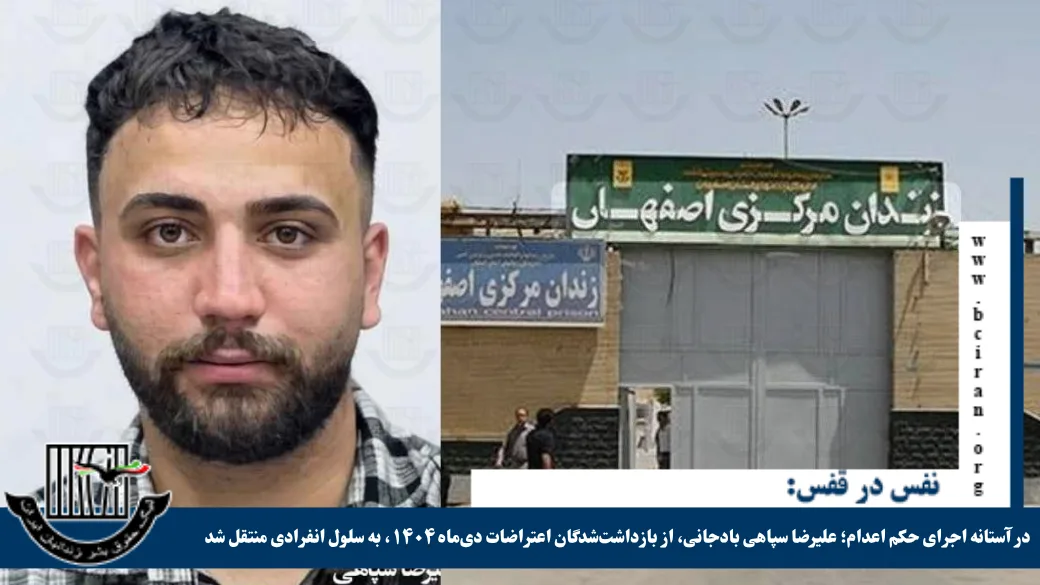
Breathing in Confinement, Saturday, 12 September 2026: Alireza Sepahi Badjani, a political prisoner sentenced to death who was arrested during the 8 January protests in Isfahan, has been transferred to solitary confinement in Isfahan Prison for the implementation of his death sentence, while the outcome of his legal applications remains unclear.
According to Breathing in Confinement, the news outlet of the Prisoners’ Rights League in Iran, published reports indicate that Alireza Sepahi, 25, one of the defendants in the case known as the “Alikhani Square case”, has been transferred to solitary confinement ahead of his execution. He had previously come close to execution. His sentence was due to be carried out publicly in Alikhani Square, Isfahan, on 28 July, but the execution was halted after he suffered a cardiac attack shortly before it was due to take place and was transferred to hospital.
Alireza Sepahi was arrested at his home on 10 January, together with his mother. He is one of the defendants in the Alikhani Square case who was tried on allegations of involvement in the killing of four police officers during the protests of 8 January.
Published reports concerning the arrest and interrogation of the defendants in this case allege that they and their families were subjected to pressure and violence. According to these reports, Alireza Sepahi’s mother was tortured in front of him, while Alireza and Abolfazl Sepahi were also beaten and tortured in the presence of members of their families. Some defendants in the case have also stated during court proceedings that they were subjected to torture, sexual assault, and threats of rape in an attempt to force them to accept or repeat the allegations against them.
Statements obtained without free consent and under coercion cannot constitute a valid or fair basis for imposing a criminal sentence, particularly a sentence involving deprivation of life. Nevertheless, human rights reports concerning this case indicate that confessions allegedly obtained under pressure were relied upon during the judicial proceedings and in the issuance of the sentences.
Following the Supreme Court’s acceptance of Alireza Sepahi’s application for retrial, the sentence against him was overturned and the case was referred to a parallel branch for reconsideration. However, according to published reports, the parallel branch subsequently paved the way for the implementation of the death sentence once again, without holding an effective hearing or fully reconsidering the defence arguments in the case.
On 2 September, Alireza Sepahi’s lawyer, Shahrzad Shahbazi, announced that Branch 39 of the Supreme Court had accepted her client’s appeal and referred the case to a parallel court for reconsideration. However, Branch Two of the Isfahan Revolutionary Court rejected the application for retrial without convening a hearing. His lawyer had also announced that she would submit a new application for retrial on 5 September. The outcome of this legal action remains unclear.
Alireza Sepahi’s renewed transfer to solitary confinement comes after his previous execution was halted because of a cardiac episode. His death sentence had been scheduled to be carried out publicly in Alikhani Square on 28 July—the same location to which the case links the events that gave rise to the allegations against the defendants.
At least five of Alireza Sepahi’s co-defendants have so far been executed. Erfan Esfandiari and Gol Mohammad Mohammadi were executed in prison on 19 July. Abolfazl Sepahi, Alireza’s cousin, and Amirhossein Safari were publicly hanged in Alikhani Square, Isfahan, on 28 July. Ghaem Hosseini was also executed in Isfahan Central Prison on 20 August.
Executions in this case have continued despite serious human rights and fair trial concerns regarding the defendants’ arrests, the manner in which their statements were obtained, allegations of torture, and the conduct of subsequent judicial reviews. Alireza Sepahi’s renewed transfer to solitary confinement has heightened the risk of his imminent execution, further underscoring the need to halt the implementation of the sentence until the status of all pending legal applications has been clarified and the allegations of violations of his rights throughout the various stages of the judicial process have been thoroughly examined.

Leave a Reply