
Death Sentence Issued for Hadi Abbasian, Arrested in Connection with January Protests
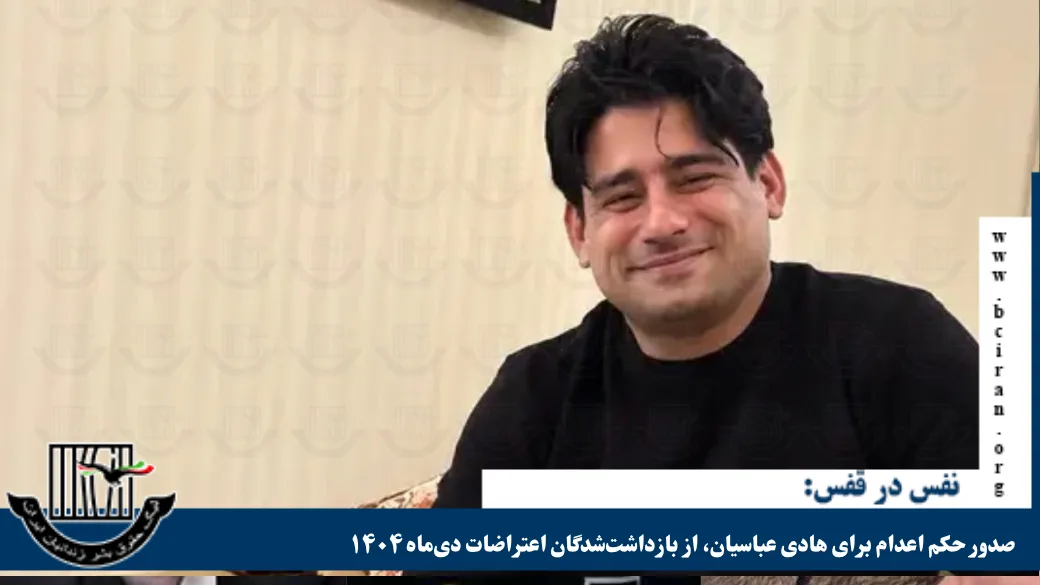
Breathing in Confinement, Tuesday, 6 October 2026: Hadi Abbasian, a 38-year-old resident of Shirvan who was arrested in connection with the January protests, has been sentenced to death by the Bojnord Revolutionary Court.
According to Breathing in Confinement, the news outlet of the Prisoners’ Rights League in Iran, the death sentence was communicated to the political prisoner on Sunday, 5 October, at Shirvan Prison. Abbasian’s case had previously been under investigation by Branch 2 of the Investigation Office of the Shirvan Revolutionary Prosecutor’s Office.
Abbasian was arrested on 13 May in the Farhang Shahr area of Shirvan. According to published reports, he was subjected to torture during the first days of his detention and, following a deterioration in his physical condition, was transferred to hospital. He was subsequently transferred to Shirvan Prison.
Reports also indicate that since his arrest, Hadi Abbasian’s family have been denied visits with him. Judicial and security authorities are also reported to have prevented his family from retaining a lawyer of their choice, thereby denying him access to trusted legal counsel. Abbasian was consequently deprived of effective access to a lawyer of his choice during the proceedings.
Prior to his arrest, Hadi Abbasian had published videos during the January protests calling on people to participate in the demonstrations.
Despite the issuance of the death sentence, the precise charge or charges on which the sentence was based, as well as the evidence relied upon by the court in Hadi Abbasian’s case, have not yet been clearly and independently disclosed. Details of the judicial proceedings and the legal basis for imposing the most severe punishment therefore remain unclear.
The imposition of a death sentence on a political prisoner, in circumstances where his family have been denied visits, he has been deprived of effective access to a lawyer of his choice, and the details of the charges and evidence against him have not been made clear, raises serious concerns regarding respect for the right to a fair trial, the right of access to legal counsel, and other legal safeguards throughout the judicial proceedings.

Leave a Reply