
Death Sentences of Three Pakdasht Protesters Upheld by Supreme Court
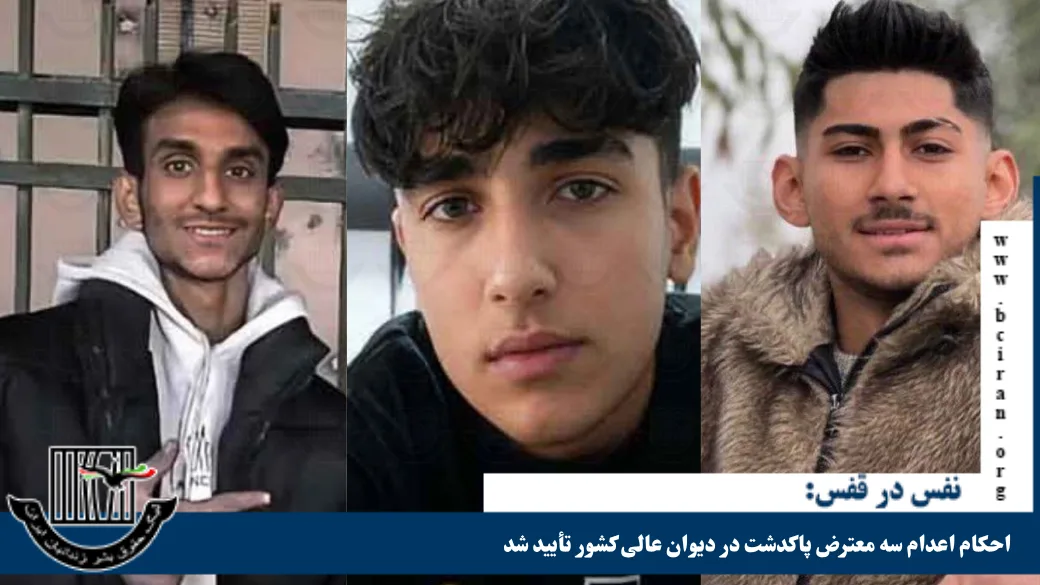
Breathing in Confinement, Tuesday, 6 October 2026: Three citizens arrested during the January protests in Pakdasht — Ehsan Hosseinipour Hesarlou, Matin Mohammadi and Erfan Amiri — have been sentenced to death in connection with the fire at the Seyed al-Shohada Mosque. Their sentences have been upheld by the Supreme Court and their cases referred to the sentence enforcement branch, raising concerns over the imminent implementation of the death sentences and violations of the defendants’ fundamental rights during the judicial proceedings.
According to Breathing in Confinement, the news outlet of the Prisoners’ Rights League in Iran, Ehsan Hosseinipour Hesarlou, Matin Mohammadi and Erfan Amiri, three individuals arrested during the January protests in Pakdasht County, were sentenced to death by the Tehran Revolutionary Court. The sentences were subsequently reviewed and upheld by the Supreme Court.
The three were tried by Branch 26 of the Tehran Revolutionary Court, presided over by Judge Iman Afshari, in connection with the fire at the Seyed al-Shohada Mosque in Pakdasht and sentenced to death. Matin Mohammadi is 17 years old and Ehsan Hosseinipour Hesarlou is 19.
According to the indictment and court rulings, the three defendants face charges including “participation in the killing of two Basij members,” “deliberate arson of a religious site,” “destruction of public property,” and “assembly and collusion against national security.”
It has been reported that following the Supreme Court’s confirmation of the sentences, the case was referred to the criminal sentence enforcement branch, increasing concerns that the executions may be carried out imminently.
At the same time, the handling of the case and the manner in which evidence was obtained have raised serious concerns regarding the defendants’ rights and fair-trial standards. According to published reports, a significant portion of the evidence in the case relies on confessions that the defendants say were obtained under pressure and torture while in detention. Questions and concerns have also been raised over whether they had effective access to independent legal counsel and were able to fully exercise their defence rights at various stages of the proceedings.
Coerced confessions, or evidence that may have been obtained through torture or other forms of pressure, cannot provide a reliable basis for imposing a sentence that deprives a person of their life. Under fundamental principles of a fair trial, every defendant must have the right to legal counsel of their choice, an effective defence, an impartial and public hearing, and independent scrutiny of the evidence.
The three were arrested during protests in Pakdasht County on 8 January. Two Basij members also lost their lives in the fire at the Seyed al-Shohada Mosque. However, the families and sources close to the case have expressed concerns about how responsibility for the incident was attributed to the defendants and the lack of transparency regarding the evidence presented to substantiate the charges.
The imposition and confirmation of death sentences against protesters, particularly in cases where questions remain over access to legal counsel, the reliability of confessions and the quality of the evidence, raise serious human rights concerns. The right to life is one of the most fundamental human rights, and depriving a person of that right without strict and full observance of fair-trial guarantees is incompatible with fundamental human rights principles.

Leave a Reply